What RSPO Certification Means for Palm-Based Emulsifiers
Date:2026-04-09
Read:
Share:
Many widely used food emulsifiers — including mono- and diglycerides (E471), DATEM (E472e), SSL (E481), and polyglycerol esters (E475) — are derived from palm-based fatty acids. Palm oil remains the most efficient vegetable oil by yield per hectare, which is why it dominates emulsifier raw material supply globally.
However, palm oil sourcing carries reputational and regulatory risks. Concerns around deforestation, biodiversity loss, and labor practices in producing regions have led major retailers — especially in Europe — to require verified sustainable sourcing. RSPO certification is the most widely used framework for managing sourcing risk and meeting retailer sustainability requirements in practice.
This blog explains what RSPO certification means in practice for buyers of palm-based emulsifiers, which certification model fits different needs, and what to verify before accepting a supplier’s claim.
What RSPO Certification Actually Covers
RSPO (Roundtable on Sustainable Palm Oil) provides a structured system for verifying how palm-based raw materials are sourced, processed, and traded across the supply chain. Certification confirms that the palm oil originates from plantations meeting environmental and social criteria, including protection of high conservation value areas and respect for labor rights.
For emulsifier buyers, RSPO certification means the palm-derived raw materials can be traced through a certified supply chain. It relates to sourcing transparency, not product functionality.
The Four Supply Chain Models: What Each One Means
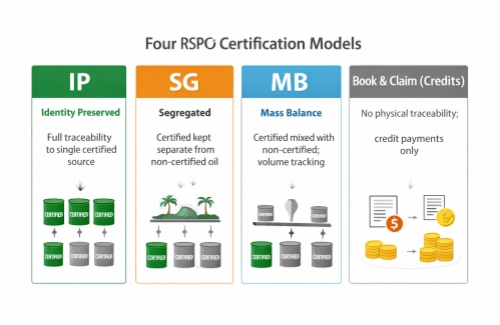
RSPO offers four certification models, which differ in traceability and cost.
Identity Preserved (IP)
Full traceability to a single certified source. The highest level of control, but also the most expensive and least flexible.
Segregated (SG)
Certified material is kept separate from non-certified oil but can be mixed from multiple certified sources. This is the most widely accepted model for food manufacturers supplying retail markets.
Mass Balance (MB)
Certified and non-certified materials may be mixed, with volumes tracked administratively. It is cost-effective and widely used but offers limited physical traceability.
Book & Claim (Credits)
No physical traceability. Certification is based on purchasing credits. This model is generally not accepted for products requiring verified sourcing claims.
For most emulsifier buyers, SG and MB are the practical options, with SG increasingly preferred in Europe.
RSPO and the EU Deforestation Regulation (EUDR)
The EU Deforestation Regulation (EUDR), expected to apply from 2026, introduces stricter requirements. Companies must prove that palm-derived products are deforestation-free, supported by geolocation data tracing back to the plantation.
RSPO certification supports compliance but does not automatically meet EUDR requirements. IP and SG models are better aligned with EUDR expectations, while MB and Book & Claim may not be sufficient.
If you supply to the EU market, confirm whether your supplier can provide geolocation data — not just an RSPO certificate.
What to Verify When Sourcing RSPO-Certified Emulsifiers
Supplier claims should always be verified with documentation:
Certificate validity: Ensure it is current and not expired Scope: Confirm the certification covers the specific emulsifier product Supply chain model: SG, MB, or others — this affects your downstream claims Transaction Certificate (TC): Required for each shipment to confirm certified status
Verification reduces supply risk and avoids compliance issues later.
Frequently Asked Questions
Does RSPO certification change how an emulsifier performs in production?
No. It only relates to sourcing and traceability, not functionality.
Is RSPO certification mandatory?
No, but many retailers require it, and regulations like EUDR are increasing compliance pressure.
Can suppliers hold multiple certifications?
Yes. Reliable suppliers often combine RSPO with ISO 22000, Halal, and Kosher certifications, simplifying procurement.
Chemsino is a food emulsifier manufacturer certified under RSPO, Halal, Kosher, ISO 9001, and ISO 22000. Our palm-based emulsifiers, including DMG (E471), DATEM (E472e), SSL (E481), and PGE (E475), are available with full certification documentation. Contact us to request certificates or discuss your sourcing requirements.