Home
Products
Emulsifier List
Application
Gallery
News
Blog
About Us
About Us
Contact Us
Your Position : Home > Blog

Emulsifiers in Sausage Processing

Date:2026-04-07
Read:
Share:
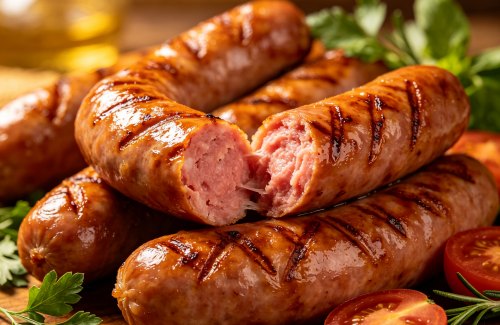
Sausage is a more technically demanding product than it appears. At its core, it's an emulsion — fat droplets dispersed in water, held together by a protein matrix extracted from the meat. When this system is stable, the result is a firm, juicy product with even texture and good yield. When it breaks down, you get fat separation, excessive cooking loss, a soft or crumbly bite, and batch-to-batch inconsistency.

Emulsifiers help stabilize this system. This blog focuses specifically on sausage processing — the problems that occur, how emulsifiers address them, and what to watch in production.


The Core Problem: Meat Emulsions Are Inherently Unstable


In sausage batter, myofibrillar proteins — extracted during mixing with salt — form a gel matrix that encapsulates fat droplets and binds water. This structure gives sausage its bite and holds it together during cooking.

However, this matrix is highly sensitive to variables that are difficult to control perfectly in industrial production: meat quality, fat content variation, mixing temperature, chopping intensity, and thermal processing. Any of these can weaken the system and cause partial or complete emulsion breakdown during cooking.

The most visible issue is fatting out — melted fat pooling under the casing or on the surface, leading to a greasy appearance and reduced yield. Another common problem is cooking loss, where water escapes due to insufficient binding, resulting in lower weight and a dry, firm texture.


How Emulsifiers Stabilize the Sausage System


Emulsifiers support the protein matrix rather than replacing it. They reduce surface tension at the fat-water interface, allowing fat to form smaller, more evenly distributed droplets that are easier to stabilize.

They also interact with proteins, improving the cohesion of the gel network and its resistance to heat during cooking.

The result is a more stable emulsion that better tolerates raw material variation and processing fluctuations — fewer fatting-out issues, lower cooking loss, and more consistent texture.

emulsifiers-in-sausage


Emulsifiers Used in Sausage Production


Mono- and Diglycerides — E471


E471 is the most widely used emulsifier in processed meat. It improves fat dispersion, helping form smaller droplets that distribute evenly through the batter and reduce fat separation during cooking.

Typical usage: 0.2–0.5% of total batter weight.


Sodium Stearoyl Lactylate — SSL (E481)


SSL interacts directly with meat proteins, strengthening the network that holds the emulsion together. This results in better heat stability, reduced cooking loss, and improved firmness and elasticity.

It is particularly useful in lower-fat formulations where protein plays a larger structural role.


Calcium Stearoyl Lactylate — CSL (E482)


CSL functions similarly to SSL but provides a milder strengthening effect. It is suitable for formulations where a softer texture is desired or where excessive firmness needs to be avoided.

CSL also supports water retention and helps reduce cooking loss.

Typical usage: 0.2–0.5%.


DATEM — Diacetyl Tartaric Acid Esters of Mono- and Diglycerides (E472e)


DATEM improves emulsion stability under heat by strengthening the interfacial film around fat droplets. It is especially useful in cooked or smoked sausages exposed to longer thermal processing.

Typical usage: 0.2–0.4%.

datem-emulsifier-chemsino


Lecithin (E322)


Lecithin is valued for its natural origin and clean-label positioning. It stabilizes the fat-water interface and is often used together with E471 to balance functionality and labeling requirements.
 

Process Conditions That Determine Whether Emulsifiers Work


Emulsifiers cannot compensate for poor process control. Two factors are critical:
 

Batter Temperature


The protein matrix forms correctly only when the batter remains cold — typically below 12°C. If the temperature rises, fat begins to melt and cannot be properly encapsulated, leading to emulsion breakdown during cooking.

Temperature should be carefully controlled using chilled water or ice.


Protein Extraction


Emulsifiers support the system, but sufficient protein extraction is essential. Salt levels (typically 1.5–2.5%) and proper mixing time are required to develop a functional gel network.

If protein extraction is insufficient, the emulsion will remain weak regardless of emulsifier use.


Frequently Asked Questions


What causes fat separation in sausage during cooking?


The most common causes are high batter temperature (above 12°C), insufficient protein extraction, and weak emulsion stability. Temperature control is usually the first factor to check.
 

Can emulsifiers reduce cooking loss in sausage?


Yes. E471 and SSL (E481) help improve water retention by stabilizing the fat-protein-water system. At 0.2–0.5% usage, noticeable reductions in cooking loss are typically observed.
 

Do emulsifiers affect sausage flavor?


At recommended levels, no. E471, E481, E482, E472e, and E322 are neutral in taste and do not impact flavor.
 

If protein extraction is insufficient, will adding more emulsifier fix the problem?


No. Emulsifiers support the protein matrix — they don't create it. If the salt level is too low or the mixing time is insufficient, the myofibrillar protein network won't form properly regardless of emulsifier dosage. Correct salt (1.5–2.5%) and mixing conditions first, then optimize emulsifier selection.
Start earning substantial
profits in your country today!
Email
Whatsapp