Home
Products
Emulsifier List
Application
Gallery
News
Blog
About Us
About Us
Contact Us
Your Position : Home > Blog

GMS vs PGE: Which Emulsifier Is Better for Fat-Based Products?

Date:2026-11-02
Read:
Share:
Choosing the right emulsifier can significantly affect the quality and stability of fat-based food products. It affects how fats interact with water, how ingredients are distributed, and how the final product performs during processing and storage. 

Glyceryl Monostearate (GMS) and Polyglycerol Esters of Fatty Acids (PGE) are both widely used non-ionic food emulsifiers. However, their different molecular structures and functional properties make them suitable for different formulations.

So, which is better for margarine, shortening, confectionery fillings, and other fat-based products? Let's compare their properties and practical applications.

1. What Are GMS and PGE?


Glyceryl Monostearate (GMS) is produced by esterifying glycerol with fatty acids, mainly stearic acid. Commercial GMS products may contain different proportions of monoglycerides and other glycerides, depending on their specifications.

GMS is a relatively lipophilic emulsifier with a typical HLB value of around 3–4. It is commonly used to modify fat properties, improve texture, and support emulsification in food products.

Polyglycerol Esters of Fatty Acids (PGE) are made by esterifying polyglycerol with edible fatty acids. Their molecular structure can vary depending on the degree of glycerol polymerization and the type of fatty acids used.

Unlike GMS, PGE is available in grades with a wider range of HLB values, generally around 5–13. This gives manufacturers more flexibility when developing different fat-based emulsions.
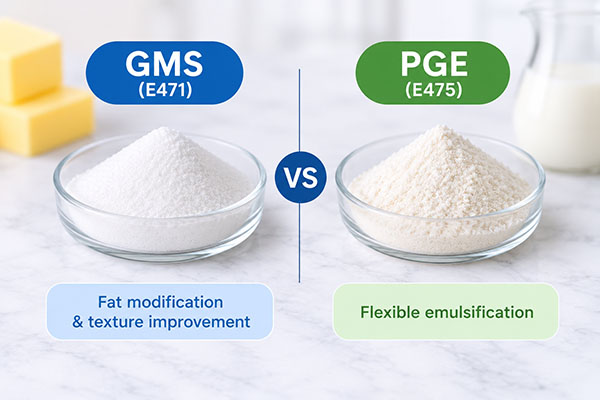
In simple terms, GMS is commonly selected for fat modification and texture improvement, while PGE offers more flexibility in controlling emulsification.

GMS VS PGE emulsifier

2. GMS vs PGE: Key Differences

 
Property GMS PGE
E-number E471 E475
Full name Glyceryl Monostearate Polyglycerol Esters of Fatty Acids
Structure Glycerol fatty acid esters Polyglycerol fatty acid esters
Ionic nature Non-ionic Non-ionic
Typical HLB 3–4 5–13
Main functionality Fat modification and texture improvement Emulsification and interfacial stabilization
Hydrophilic-lipophilic balance More lipophilic Adjustable
Formulation flexibility Depends on grade Wide range of grades


The main difference is their balance between water and oil affinity.

GMS has a relatively low HLB value, making it suitable for applications where compatibility with the fat phase is important. PGE offers a broader range of properties, allowing manufacturers to select a grade according to the required emulsion system.

It is worth noting that HLB values are only a starting point for emulsifier selection. Actual performance also depends on fatty acid composition, fat type, processing conditions, and interactions with other ingredients.


3. How Do GMS and PGE Work in Fat-Based Products?


GMS: Improving Fat Structure and Product Texture


GMS is commonly used when manufacturers need to improve the physical properties of fat-based formulations. It can influence fat crystallization, modify product consistency, and help improve the distribution of ingredients. These properties are useful in products that require a smooth texture and stable physical structure.

For example, in shortening and confectionery fillings, suitable GMS grades can help achieve the desired consistency and processing characteristics. GMS can also contribute to emulsion stability, but its relatively low HLB means it is not suitable for every water-oil system.

PGE: Providing Flexible Emulsification


PGE offers a wider range of emulsification properties because its HLB can be adjusted through its molecular structure. Depending on the grade, it can help reduce interfacial tension between oil and water, improve ingredient dispersion, and support emulsion stability.

In margarine and fat spreads, selected PGE grades can help stabilize water droplets dispersed in the continuous fat phase. 
PGE can also influence fat crystallization and product structure in certain confectionery and chocolate-related formulations. Its main advantage is formulation flexibility. Manufacturers can select different PGE grades to address specific emulsification and processing requirements.

4. Applications of GMS and PGE in Fat-Based Foods


The choice between GMS and PGE depends largely on the final product and its functional requirements.
 
Application GMS PGE
Margarine and fat spreads Helps modify fat structure and texture Selected grades support W/O emulsion stability
Shortening Helps control physical properties and consistency Can provide additional emulsification functionality
Confectionery fillings Helps improve texture and consistency Can support emulsification and fat crystallization control
Chocolate and compound coatings Used in selected fat-based formulations Certain grades help modify fat crystallization and processing properties
Bakery fat systems Supports fat modification and formulation performance Provides additional emulsification options
Nut and oil-based spreads Can help modify texture Selected grades may help control oil-water interfaces

Margarine and Fat Spreads


Margarine is typically a water-in-oil (W/O) emulsion, meaning that small water droplets are distributed throughout a continuous fat phase. Maintaining this structure is important for product consistency, water distribution, and storage stability.

GMS can contribute to fat structure and texture, while suitable PGE grades can provide interfacial stabilization. Depending on the formulation, manufacturers may use PGE alone or combine it with other emulsifiers to achieve the required performance.

Confectionery Fillings

Fat-based fillings used in biscuits, wafers, and confectionery products need a smooth texture and good resistance to oil separation.
GMS can help modify the fat structure and improve consistency. Selected PGE grades can provide additional control over emulsification and fat crystallization.
The most suitable option depends on the fat composition, processing temperature, and desired texture.

5. Can GMS and PGE Be Used Together?


Yes. GMS and PGE can be combined in certain food formulations to achieve complementary functions. For example, GMS may contribute to fat structure and consistency, while PGE provides additional emulsification functionality.

This combination may be useful in complex fat-based systems where manufacturers need to control both physical texture and emulsion stability. However, using two emulsifiers does not automatically improve product performance. Their compatibility and dosage should be evaluated through laboratory trials and production testing.

6. How to Choose the Right Emulsifier?


There is no universal answer to whether GMS or PGE is better. Before making a decision, food manufacturers should consider four important factors:

1. Product formulation

Identify the oil and fat composition, water content, and required emulsion type. Different formulations may require different emulsifier properties.

2. Desired functionality

If the main goal is to modify fat structure and improve consistency, GMS is a practical starting point. If the formulation requires more flexible emulsification, PGE may be worth evaluating.

3. Processing conditions

Mixing temperature, cooling rate, shear intensity, and storage conditions can all affect emulsifier performance. Testing under actual production conditions is essential.

4. Emulsifier specifications

Not all GMS or PGE products perform the same way. Monoglyceride content, fatty acid composition, HLB value, and product purity should be considered when selecting a grade.

Final Thoughts 


GMS and PGE are both useful emulsifiers for fat-based food products, but they serve different formulation needs. GMS is commonly used to improve fat structure, texture, and product consistency. PGE offers greater flexibility in emulsification and can help stabilize different oil-water systems, depending on the grade.

Rather than asking which emulsifier is universally better, manufacturers should focus on which one delivers the required performance in their specific formulation.

CHEMSINO supplies GMS and PGE food emulsifiers for different food processing applications. If you are looking for a suitable emulsifier for margarine, shortening, confectionery, or other fat-based products, get in touch with us for product specifications and technical support.

Frequently Asked Questions


1. What is the main difference between GMS and PGE?

GMS has a relatively low HLB value and is commonly used for fat modification and texture improvement. PGE has a wider HLB range, offering more flexibility in emulsification.

2. Is PGE better than GMS for margarine?

Not always. Selected PGE grades are useful for stabilizing water-in-oil emulsions, while GMS can contribute to fat structure and texture. The choice depends on the margarine formulation and required product properties.

3. Can GMS and PGE be used together?

Yes. They can be combined to provide complementary emulsification and fat-modifying functions. However, their compatibility and dosage should be tested before commercial production.

4. What are the E-numbers of GMS and PGE?

GMS is generally classified under E471 (mono- and diglycerides of fatty acids), while PGE is classified as E475 (polyglycerol esters of fatty acids).
Start earning substantial
profits in your country today!
Email
Whatsapp