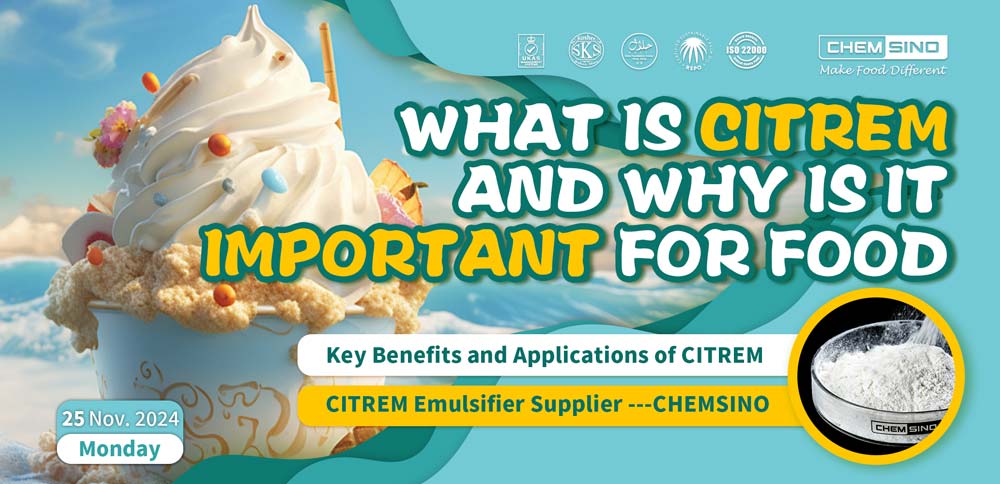
A food ingredient list shows every ingredient used in a packaged food. Ingredients are listed in descending order by weight, meaning the ingredient present in the largest amount appears first. Functional ingredients such as emulsifiers, preservatives, and stabilizers are usually listed near the end because they are used in much smaller quantities.
Most people read the front of a package — the health claims, the branding, the "natural" or "no preservatives" badges. The ingredient list is on the back, in small print, and most people skip it. That's a mistake, because the ingredient list is where the real information lives.
Here's how to read it accurately, what the common patterns mean, and what to actually look for.
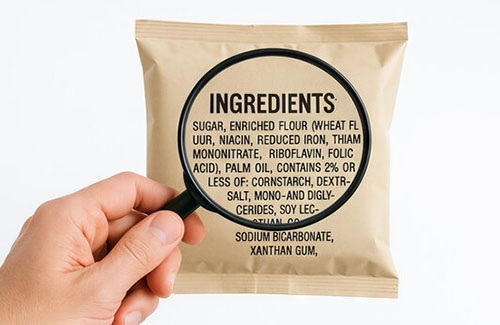
Why Ingredient Lists Matter?
Food labels are designed to provide transparency about what's inside a product. Whether you're managing allergies, comparing products, or simply curious about food ingredients, the ingredient list offers valuable information.
By understanding ingredient labels, you can:
# Compare similar products
# Identify allergens
# Understand the function of food additives
# Evaluate product quality
# Make purchasing decisions based on your dietary preferences
For food manufacturers and distributors, clear ingredient labeling also helps ensure regulatory compliance and builds consumer trust.
Ingredients Are Listed by Weight
Ingredients are listed in descending order by weight — the ingredient present in the largest amount comes first, and so on down to the smallest.
This single rule tells you more than anything else on the label. The first three to five ingredients are the majority of the product by weight. Everything after that exists in smaller and smaller quantities.
A granola bar that lists "oats, honey, almonds" as its first three ingredients is a fundamentally different product from one that lists "sugar, vegetable oil, oats" — even if they look similar on the shelf and have similar calorie counts.
Practical takeaway: Read the first five ingredients. They tell you what the food actually is.
How to Spot Hidden Sugar?
Sugar is the ingredient most systematically obscured in food labeling, and it's done through naming — not deception exactly, but fragmentation.
Food manufacturers can list multiple forms of sugar as separate ingredients, which pushes each one further down the list than if they were combined. A product with 15g of added sugar might list four different sugar sources, none of which appear in the first three ingredients.
Names that all mean sugar:
# Sugar, cane sugar, beet sugar, brown sugar, raw sugar
# High fructose corn syrup, corn syrup, corn syrup solids
# Dextrose, maltose, sucrose, fructose, lactose, glucose
# Fruit juice concentrate, evaporated cane juice
# Honey, agave nectar, maple syrup, molasses
# Maltodextrin (partially — it behaves like sugar metabolically)
What to look for: Count how many sugar variants appear in the ingredient list. If there are three or four, add their combined contribution to get the real sugar picture — which is now also reflected in the "Added Sugars" line on the Nutrition Facts label.
Whole Grains vs. Refined Grains
"Made with whole grains" on the front of a package can mean almost anything. The ingredient list tells you the truth.
Whole grain means the bran, germ, and endosperm are all present. Look for: whole wheat flour, whole grain oats, whole grain corn, brown rice, whole rye.
Refined grain means the bran and germ have been removed, leaving mostly starch. Look for: enriched flour, wheat flour (without "whole"), white flour, rice flour.
The key is position. If "whole wheat flour" appears after "enriched flour" in the list, the product contains more refined grain than whole grain by weight — regardless of what the front label says.
What to look for: Whole grain ingredients should appear first if a product genuinely prioritizes them. "Enriched flour" at position one, followed by "whole wheat flour" at position three, means you're buying a refined-grain product with some whole grain added.
Understand Different Types of Ingredients
This is where most ingredient lists get long and unfamiliar. Emulsifiers, stabilizers, preservatives, colors, and flavor enhancers all appear — often by chemical name — and can look alarming if you don't know what they are.
The reality: most food additives are there for specific technical reasons, are present in very small amounts, and have been evaluated for safety by regulatory bodies before approval. Unfamiliar names are not the same as unsafe ingredients.
Here's what the main categories do:
Emulsifiers keep oil and water mixed. Without them, peanut butter separates, salad dressings split, and cake batter doesn't hold together. For example, emulsifiers such as Distilled Monoglycerides (E471), DATEM (E472e), and Sodium Stearoyl Lactylate (SSL, E481) are widely used in commercial baking because they not only stabilize emulsions but also improve dough tolerance, increase loaf volume, soften crumb texture, and extend freshness.
Stabilizers and thickeners control texture and prevent separation. Common ones: xanthan gum, guar gum, carrageenan, pectin, modified starch, carboxymethylcellulose.
Preservatives extend shelf life by slowing microbial growth or oxidation. Common ones: sodium benzoate, potassium sorbate, calcium propionate, tocopherols (vitamin E — a natural antioxidant), ascorbic acid (vitamin C).
Flavor enhancers amplify existing flavors without contributing flavor themselves. Monosodium glutamate (MSG) is the most well-known. Disodium inosinate and disodium guanylate are often used alongside it.
Colors — both artificial (FD&C Red 40, Yellow 5) and natural (annatto, turmeric, beet extract, caramel color) — appear in many processed foods.
What to look for: If an additive appears near the end of the ingredient list, it's present in a very small quantity. The question worth asking isn't "can I pronounce this?" — it's "why is this here, and do I have a specific reason to avoid it?"
Common Food Emulsifiers You May See on Ingredient Labels
| Ingredient |
E Number |
Function |
Common Foods |
| E471 |
Distilled Monoglycerides |
Emulsifier |
Bread, Cakes |
| DATEM |
E472e |
Dough Improver |
Bread |
| SSL |
E481 |
Dough Strengthener |
Bakery |
| Lecithin |
E322 |
Emulsifier |
Chocolate |
| Polysorbate 60 |
E435 |
Stabilizer |
Ice Cream |
E Numbers: The European System
In the EU and many other markets, food additives are listed by E number rather than chemical name. E numbers are assigned by the European Food Safety Authority (EFSA) after safety evaluation — having an E number means an additive has been reviewed and approved for use, not that it's synthetic or harmful.
Common E numbers and what they are:
| E Number |
Additive |
Function |
| E322 |
Lecithin |
Emulsifier |
| E471 |
Mono- and diglycerides of fatty acids |
Emulsifier |
| E472e |
Diacetyl tartaric acid esters of mono- and diglycerides (DATEM) |
Emulsifier |
| E481 |
Sodium stearoyl lactylate (SSL) |
Emulsifier |
| E433 |
Polysorbate 80 |
Emulsifier |
| E415 |
Xanthan gum |
Stabilizer/thickener |
| E407 |
Carrageenan |
Stabilizer/thickener |
| E202 |
Potassium sorbate |
Preservative |
| E211 |
Sodium benzoate |
Preservative |
| E621 |
Monosodium glutamate |
Flavor enhancer |
| E102 |
Tartrazine (Yellow 5) |
Color |
What to look for: If you're buying in an EU-format market, E numbers and chemical names are interchangeable — they refer to the same substances. A label that lists "E471" is saying the same thing as one that lists "mono- and diglycerides of fatty acids."
Allergen Declarations
In most markets, the top eight (US) or fourteen (EU) allergenic ingredients must be declared clearly on the label, either within the ingredient list or in a separate "Contains:" statement.
US top 8 allergens: Milk, eggs, fish, shellfish, tree nuts, peanuts, wheat, soybeans. (Sesame was added as the 9th in 2023.)
EU top 14 allergens: Cereals containing gluten, crustaceans, eggs, fish, peanuts, soybeans, milk, nuts, celery, mustard, sesame, sulphur dioxide/sulphites, lupin, molluscs.
"May contain" statements (e.g., "may contain traces of nuts") are voluntary in most markets — they indicate shared production equipment or facility, but their absence doesn't guarantee freedom from cross-contamination.
What to look for: If you manage a food allergy or intolerance, read both the ingredient list and any "Contains:" declaration. For severe allergies, "may contain" warnings matter.
Final Thoughts
Reading the ingredient list doesn't have to be complicated. Once you understand how ingredients are listed and the roles different additives play, food labels become much easier to interpret.
Rather than viewing all unfamiliar ingredients with suspicion, it's helpful to understand why they are used and how they contribute to food quality, safety, and consistency.
Whether you're a consumer choosing products for your family or a food industry professional evaluating formulations, knowing how to read ingredient labels is an essential skill.
Looking for Food-Grade Emulsifiers?
CHEMSINO manufactures food-grade emulsifiers and stabilizers — including GMS, SSL, sorbitan esters, and polysorbates — that appear in the ingredient lists of baked goods, dairy products, confectionery, and beverages worldwide. We believe transparency in food ingredients starts with understanding what those ingredients are and why they're there.
Our technical team can recommend the right emulsifier based on your application and production requirements. Contact us today for samples, technical support, or a customized solution.
Frequently Asked Questions
Why are ingredients listed in a specific order?
Ingredients are generally listed in descending order by weight, with the largest amount appearing first.
Are food emulsifiers safe?
Yes. Food safety authorities evaluate approved food emulsifiers, which must meet strict regulatory standards before they can be used in food products.
What does E471 mean?
E471 refers to mono- and diglycerides of fatty acids, a commonly used emulsifier that improves texture, stability, and shelf life in bakery, dairy, and other food products.
Should I avoid foods with long ingredient lists?
Not necessarily. A longer ingredient list may reflect the inclusion of functional ingredients that improve safety, texture, or product stability.
Why do packaged foods use food additives?
Food additives help maintain product quality, improve texture, prevent spoilage, enhance processing, and ensure consistent performance throughout the product's shelf life.

 Emulsifier List
 About Us


.jpg)