Home
Products
Emulsifier List
Application
Gallery
News
Blog
About Us
About Us
Contact Us
Your Position : Home > Blog

How to Read a Food Emulsifier E-Number Label

Date:2026-03-18
Read:
Share:
If you've ever checked a food label and noticed codes like E471 or E472c, you're not alone. These are called E-numbers, and they're the standardized way food additives are identified on labels across the EU and many global markets. For food manufacturers, buyers, and R&D teams, knowing how to read them is a practical skill, not just a regulatory formality.

This blog explains what E-numbers are, walks through the most common emulsifier codes you'll encounter, and clears up a few misconceptions that tend to create unnecessary confusion.


What Are E-Numbers?


E-numbers are codes assigned to food additives that have been reviewed and approved for use in the European Union. Each number corresponds to a specific ingredient that has passed safety and functionality assessments by the European Food Safety Authority (EFSA).

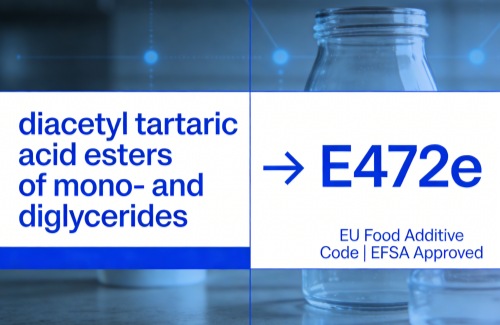
The system exists for a practical reason: instead of printing full chemical names like "diacetyl tartaric acid esters of mono- and diglycerides" on every label, manufacturers use E472e. It keeps labels consistent, readable, and usable across different languages and markets.

Datem E number

E-numbers cover a broad range of additives — preservatives, colorings, stabilizers, and emulsifiers among them. Emulsifiers are one of the most common categories you'll encounter in processed foods.


Common Food Emulsifier E-Numbers You Should Know


E471 — Mono- and Diglycerides of Fatty Acids


One of the most widely used emulsifiers in food production. Found in bakery products, dairy, margarine, and spreads. Its primary functions are improving crumb softness, retaining moisture, and stabilizing fat-water systems. In bread formulas, it's typically used at 0.3–0.5% of flour weight.
 

E472e — DATEM (Diacetyl Tartaric Acid Esters of Mono- and Diglycerides)


A key emulsifier in bread production. DATEM strengthens the gluten network, improves dough tolerance, and increases loaf volume. It's particularly common in industrial sandwich bread and high-volume baked goods.
 

E472c — CITREM (Citric Acid Esters of Mono- and Diglycerides)


Used in margarine, processed meat, and confectionery. CITREM provides both emulsifying and mild acidifying properties, making it useful in applications where pH control matters alongside emulsion stability.
 

E481 — Sodium Stearoyl Lactylate (SSL)


Improves dough strength, crumb softness, and shelf life in baked goods. Often used alongside E471 in bread improver formulations for a combined softening and structure effect.
 

E476 — PGPR (Polyglycerol Polyricinoleate)


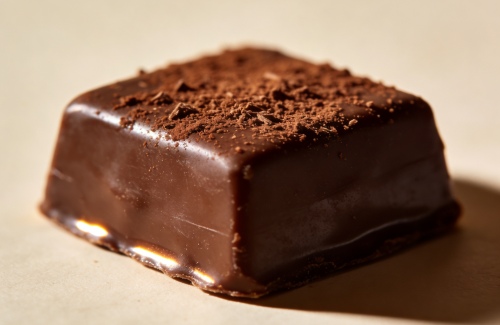
A lipophilic emulsifier primarily used in chocolate and compound coatings to reduce viscosity and improve flow properties during processing. At typical usage levels of 0.2–0.5%, PGPR allows manufacturers to reduce cocoa butter content without affecting how the chocolate pours or coats. It is also used in low-fat chocolate formulations to maintain smooth texture and consistent mouthfeel.

E476 in chocolate


E433 — Polysorbate 80


Used in beverages, ice cream, sauces, and non-dairy creamers to stabilize emulsions, particularly at low-fat levels. Effective at keeping fine oil droplets evenly dispersed.


How to Read an E-Number Label


Step 1 — Identify the code. Look for ingredients starting with "E" followed by a number. In the emulsifier category, E4xx codes are the ones to focus on.

Step 2 — Match it to its function. Once you know the code, you can quickly identify what it does. E471 in a bread label means the manufacturer is managing crumb softness and shelf life. E472e means they're working on dough strength and volume. E433 in a creamer means emulsion stabilization at low fat content.

Step 3 — Consider position in the ingredient list. EU labeling rules require ingredients to be listed in descending order by weight. An emulsifier listed near the end of a long ingredient list is present in small quantities, which is normal, since most emulsifiers are effective at 0.1–1% of the total formulation.

Step 4 — Check market-specific approvals. E-numbers are EU approvals, but most are also accepted under equivalent frameworks in other markets — including FDA GRAS status in the US, and approvals under Codex Alimentarius for international trade. If you're sourcing for multiple markets, verify each ingredient's status in your target regions.


Common Misunderstandings About E-Numbers


"E-numbers mean artificial chemicals."


Not accurate. Many E-number ingredients are naturally derived. Lecithin (E322) comes from soybeans or sunflowers. Mono- and diglycerides (E471) are produced from vegetable oils. The E-number system covers both synthetic and natural-origin additives.

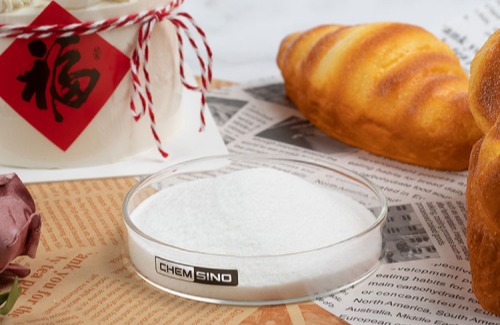
Chemsino GMS 90


"E-numbers are unsafe."


E-numbers are only assigned after rigorous safety evaluations. EFSA sets acceptable daily intake (ADI) levels and maximum usage limits for each approved additive. The presence of an E-number on a label indicates regulatory oversight, not a safety concern.
 

"A shorter ingredient list means a better product."


Not necessarily. Removing emulsifiers from a formula often leads to shorter shelf life, inconsistent texture, and reduced processing tolerance. The functional role of each ingredient matters more than the length of the list.
 

"All emulsifiers do the same thing."


Different emulsifiers serve different functions, and substituting one for another without understanding those differences can affect product quality significantly. E471 improves softness; E472e improves dough structure; E433 stabilizes emulsions at low fat levels. Choosing correctly depends on the product type and processing conditions.
 

A Note for Food Manufacturers and Buyers


Understanding E-numbers is not just useful for reading labels — it directly supports better formulation decisions, cleaner supplier communication, and faster regulatory review when entering new markets.

Chemsino is a food emulsifier manufacturer and supplier based in Zhengzhou, China, serving customers in over 50 countries across Europe, South America, the Middle East, and Africa. We supply a full range of food-grade emulsifiers, including Mono- and Diglycerides (E471), DATEM (E472e), SSL (E481), Mono Propylene Glycol (E1520), and Polysorbates series, all certified Halal, Kosher, ISO 9001, ISO 22000, and RSPO. Contact us to discuss your application or request samples.
Related Blog
What Emulsifier is Used in Ice Cream
15 Mar 2024
Emulsifiers are essential parts in ice cream production, playing a crucial role in creating the fantastic and popular product. This post provides a comprehensive overview of ice cream emulsifiers, including why emulsifiers are used in ice cream, common emulsifiers for ice cream(Lecithin, mono- and diglycerides, Polysorbate 80, and Polyglycerol Esters of Fatty Acids), natural vs. Synthetic emulsifiers in ice cream, as well as ice cream emulsifiers buying guidance.
What are Emulsifiers in Cosmetics and Skincare
19 Aug 2024
Emulsifiers enhance cosmetic formulations by providing a smooth, consistent texture and improving performance. In this blog, we offer an in-depth exploration of cosmetic emulsifiers, including their definitions, types, benefits, and popular examples. This guide provides essential insights for manufacturers looking to refine and elevate their product formulations.
Polyglycerol Esters (E475) vs. Propylene Glycol Esters (E477)
31 Oct 2025
Polyglycerol Esters (PGE, E475) and Propylene Glycol Esters (PGMS, E477) are essential food emulsifiers used to stabilize formulations and improve product quality. While PGE offers excellent heat stability and structure enhancement for baked goods, PGMS provides smoothness and uniform emulsions for creamy and frozen systems. Understanding their functions and differences enables food technologists to select the best emulsifier combination for optimal performance in bakery, dairy, and confectionery applications.
Start earning substantial
profits in your country today!
Email
Whatsapp