Home
Products
Emulsifier List
Application
Gallery
News
Blog
About Us
About Us
Contact Us
Your Position : Home > Blog

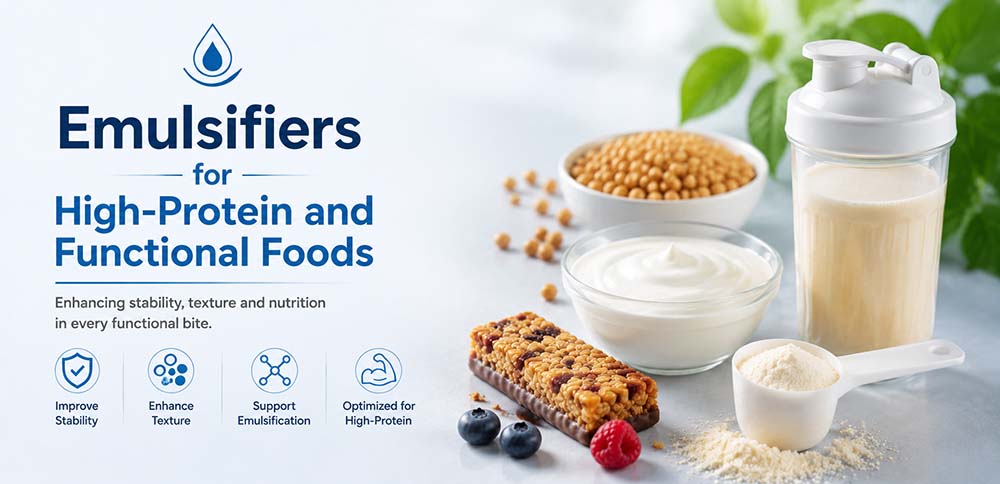
Emulsifiers for High-Protein and Functional Foods

Date:2026-07-24
Read:
Share:
High-protein foods are technically demanding to formulate. Protein bars go hard within days. Protein drinks separate on the shelf. High-protein bread goes stale faster than standard bread. Plant-based meat releases fat during cooking instead of holding it.

In each case, the emulsifier system is part of the solution — but only if you understand why high protein creates the problem in the first place.

Emulsifiers for High-Protein and Functional Foods


Why Protein Makes Emulsification Harder


Proteins are natural emulsifiers. Whey, casein, soy, and pea protein all adsorb to oil-water interfaces and form stabilizing films. In standard food systems, this is helpful. In high-protein formulations, it creates three specific problems.

Interface competition. Added emulsifiers — lecithin, monoglycerides, polysorbates — must compete with proteins for the same oil-water interface. A thick protein film already in place reduces the emulsifier's access and contribution to stability.
Protein aggregation. At high concentrations, near the isoelectric point (the pH where the protein carries no charge), or above the denaturation temperature, proteins aggregate. Aggregated proteins are more viscous, less effective as emulsifiers, and more likely to cause graininess or sedimentation.
Gluten dilution in bakery. Adding protein ingredients (whey, soy, pea) to bread dough dilutes gluten — the network that traps gas and gives bread its structure. More protein means weaker dough, lower volume, and faster staling. Emulsifiers must compensate.

Different proteins create different versions of these problems. Whey protein is highly soluble but heat-sensitive — it denatures above 75–80°C, which matters for UHT beverages. Pea and soy protein aggregate near pH 4.5, which matters for acidified protein drinks. Casein is more heat-stable but calcium-sensitive. Understanding your protein source is the starting point for selecting the right emulsifier.

Application-by-Application Solutions


High-Protein RTD Beverages


The challenge: Maintaining a stable O/W emulsion through UHT processing (135–140°C), 12–18 months ambient shelf life, and protein concentrations that create aggregation risk.
What works:
Lecithin (soy or sunflower) at 0.1–0.3% is the most widely used emulsifier in protein beverages. Lecithin phospholipids and milk proteins form mixed interfacial films that are more stable than either component alone — one of the few cases where protein-emulsifier synergy works in your favor. Sunflower lecithin is preferred in non-GMO and soy-allergen-free positioned products.
Polysorbate 80 at 0.05–0.2% improves emulsion stability and reduces creaming in oil-containing protein systems. Its HLB of 15.0 makes it effective at stabilizing fine oil droplets in the aqueous protein matrix without disrupting protein film integrity at typical dosage levels.
Processing note: Emulsifiers must be fully dispersed and equilibrated before the UHT step. Two-stage homogenization (15–20 MPa first stage, 3–5 MPa second stage) with emulsifier present before the thermal step is standard. Test shelf life at elevated storage temperature — emulsions that look stable immediately after processing often show creaming or flocculation after weeks at 37–40°C.


High-Protein Bread and Baked Goods


The challenge: Added protein (whey, soy, pea) dilutes gluten, competes with starch and gluten for water, increases dough stickiness, and accelerates staling — all simultaneously.
What works:
SSL (Sodium Stearoyl Lactylate) at 0.3–0.5% flour basis is the most effective single emulsifier for high-protein bread. SSL binds directly to gluten proteins, strengthening the gluten network and partially compensating for the dilution effect. It also improves gas retention during fermentation. Standard bread uses SSL at 0.25–0.35%; high-protein bread often requires the upper end of the range or above.
DATEM at 0.25–0.5% complements SSL. Where SSL works through direct protein binding, DATEM modifies dough viscoelasticity more broadly. The SSL + DATEM combination is particularly effective in doughs with 20%+ added protein that would produce poor volume on either emulsifier alone.
DMG at 0.4–0.6% (higher than standard bread) provides anti-staling through starch complexation. Protein-starch competition reduces DMG's effectiveness at standard dosage — increase accordingly and consider alpha-gel preparation for more consistent distribution.
Lecithin at 0.3–0.5% improves fat distribution in enriched high-protein bakery products and contributes to softer crumb texture over shelf life.


Protein Bars


The challenge: Protein bars harden progressively after production as protein matrices set and moisture redistributes. Achieving soft, chewy texture on day 1 that remains acceptable at the end of shelf life is the defining formulation problem.
What works:
Lecithin at 0.5–1.0% delays protein matrix hardening and improves fat distribution throughout the bar matrix. It also acts as a release agent during bar forming and cutting.
SSL at 0.2–0.4% contributes to a softer texture in protein bar matrices containing wheat or oat components by modifying how the starch and protein fractions interact.
Water activity management is as important as emulsifier selection in protein bars. Hygroscopic protein ingredients pull water from other components over time, accelerating hardening. Humectants (glycerol, sorbitol, invert sugar) combined with the emulsifier system address both initial texture and shelf life stability.


Plant-Based Meat Alternatives


The challenge: Replicating the cohesive texture, juicy mouthfeel, fat marbling appearance, and cooking behavior of real meat using pea protein, soy protein, methylcellulose, and vegetable fat — without the muscle fiber structure that gives meat its unique texture.
What works:
Sunflower lecithin at 0.3–1.0% is the preferred emulsifier in clean-label plant-based meat. It stabilizes fat-protein interfaces within the extruded or formed matrix, distributes fat evenly (preventing fat pooling), and supports Maillard browning during cooking. Sunflower is preferred over soy lecithin in products where soy is not already a declared ingredient.
GMS or DMG at 0.2–0.5% helps stabilize the fat phase and contributes to cooking texture — preventing fat release during the cooking step that makes plant-based burgers look greasy on the pan.
PGE at 0.1–0.3% improves fat binding within the protein matrix in extruded products, contributing to texture uniformity after cooking.
Important caveat: Texture in plant-based meat is primarily determined by the protein texturization step (extrusion conditions, protein-to-water ratio, temperature profile) — not the emulsifier. Optimize protein processing first. The emulsifier system is a refinement, not a foundation.


High-Protein Dairy (Greek Yogurt, Skyr, Fortified Milk)


The challenge:
 Increasing protein content beyond the natural dairy matrix creates syneresis (whey weeping), graininess, and texture inconsistency in concentrated dairy products.


What works:

Lecithin
 at 0.05–0.15% contributes to smoother texture and reduced syneresis in Greek-style products. The effect is modest compared to the protein matrix and stabilizer system, but consistent.

GMS
 at 0.1–0.2% improves fat emulsification in fortified whole-milk products and contributes to creamier mouthfeel.

Stabilizer system (carrageenan + guar or locust bean gum) is the primary tool for managing syneresis and protein sedimentation in high-protein dairy. Emulsifiers support but do not replace an effective stabilizer blend.

Functional Beverage Emulsions (Omega-3, Fat-Soluble Vitamins)

The challenge: Encapsulating and stabilizing oil-soluble bioactives (omega-3, vitamins A, D, E, K, curcumin, CoQ10) in aqueous functional beverages, with stability against oxidation and phase separation over 12–18 months.

What works:

Polysorbate 80 at 0.05–0.2% produces the smallest oil droplets at the lowest emulsifier usage — critical because smaller droplets oxidize more slowly (less surface area per unit volume of oil). It is the standard choice for vitamin and nutraceutical emulsification in clear or near-clear beverages.
Modified food starch (OSA-modified) at 0.5–2.0% is the primary emulsifier in cloudy beverage emulsions and the standard encapsulant in spray-dried omega-3 preparations. It forms a thick, protective interfacial film that resists oxidative damage better than small-molecule emulsifiers.
Sunflower lecithin at 0.1–0.2% is increasingly used as a cleaner-label alternative to Polysorbate 80 in nutraceutical applications. Lyso-lecithin (enzymatically modified) has significantly better emulsification efficiency than standard lecithin and approaches Polysorbate 80 performance in some systems.
Antioxidant system: No emulsifier alone prevents oxidation of polyunsaturated fatty acids. Mixed tocopherols (0.05–0.1%), ascorbyl palmitate (0.01–0.05%), and rosemary extract are standard co-ingredients. The emulsifier and antioxidant systems must be designed together.

Three Factors That Apply Across All High-Protein Applications


pH and the Isoelectric Point


Most food proteins aggregate near their isoelectric point — where net charge approaches zero:
 
Protein Isoelectric Point (pI)
Casein ~4.6
β-Lactoglobulin (whey) ~5.1
Soy protein ~4.5
Pea protein ~4.5

Acidified protein products (flavored protein drinks, acidic coatings) formulated near pI require increased emulsifier and stabilizer dosage and careful pH control. Always verify stability at target pH through full shelf life, not just at production.


Heat and Protein Denaturation


Whey proteins denature at 75–80°C; soy proteins at 70–80°C. Denatured proteins have lower emulsifying capacity and higher aggregation tendency. In UHT systems, emulsifiers must stabilize droplets during the thermal step when proteins are denatured and throughout cooling. Test stability across the full thermal profile, not just at the endpoint.

Calcium and Divalent Cations


Added calcium, magnesium, zinc, or iron — common in fortified functional foods — destabilizes protein emulsions by screening electrostatic repulsion between protein-coated fat droplets. If your formulation includes mineral fortification, test the complete system (protein + emulsifier + minerals) at final concentrations, not the components separately.


Quick Reference

 
Application Primary Emulsifiers Typical Level Main Challenge
Protein RTD beverages Lecithin, Polysorbate 80 0.1–0.3%; 0.05–0.2% UHT stability, creaming
High-protein bread SSL, DATEM, DMG 0.3–0.5% each (flour basis) Gluten dilution, staling
Protein bars Lecithin, SSL 0.5–1.0%; 0.2–0.4% Hardening over shelf life
Plant-based meat Sunflower lecithin, GMS 0.3–1.0%; 0.2–0.5% Fat binding, mouthfeel
High-protein dairy Lecithin, GMS 0.05–0.15%; 0.1–0.2% Syneresis, texture
Nutraceutical emulsions Polysorbate 80, OSA starch 0.05–0.2%; 0.5–2.0% Oxidation, droplet size
 

Frequently Asked Questions


Why does protein interfere with emulsifiers? Proteins and food emulsifiers compete for the same oil-water interfaces. At high protein concentrations, proteins occupy interfacial space before emulsifiers can adsorb, reducing their effectiveness. The severity depends on protein type, concentration, pH, and processing temperature.

Can I just use more emulsifier to compensate for protein interference? Partially. SSL at higher dosage compensates for gluten dilution in bread; higher DMG compensates for reduced starch complexation. But dosage has a ceiling — above the effective range, additional emulsifier stops improving performance and can affect flavor or texture. Using the right emulsifier type for the specific protein-related problem is more effective than increasing dosage of the wrong one. 

What's the best emulsifier for plant-based meat? Sunflower lecithin is the most widely used for fat stabilization and mouthfeel. But texture in plant-based meat is primarily set by the protein extrusion process, not the emulsifier. Optimize protein texturization first; then optimize the emulsifier system.

Working with CHEMSINO


High-protein formulations are among the most technically demanding applications for food emulsifiers — the protein system changes how every emulsifier performs, and standard reference ranges from conventional food applications don't always transfer directly.

CHEMSINO has supplied emulsifiers — GMS, DMG, SSL, DATEM, sorbitan esters, and polysorbates — to food manufacturers across bakery, dairy, plant-based, and functional food categories for over a decade. Because emulsifiers are our only business, our technical team works with protein-emulsifier compatibility questions across real production conditions. We can help with emulsifier selection, dosage guidance for high-protein systems, and troubleshooting when protein interference is causing performance issues.
Start earning substantial
profits in your country today!
Email
Whatsapp