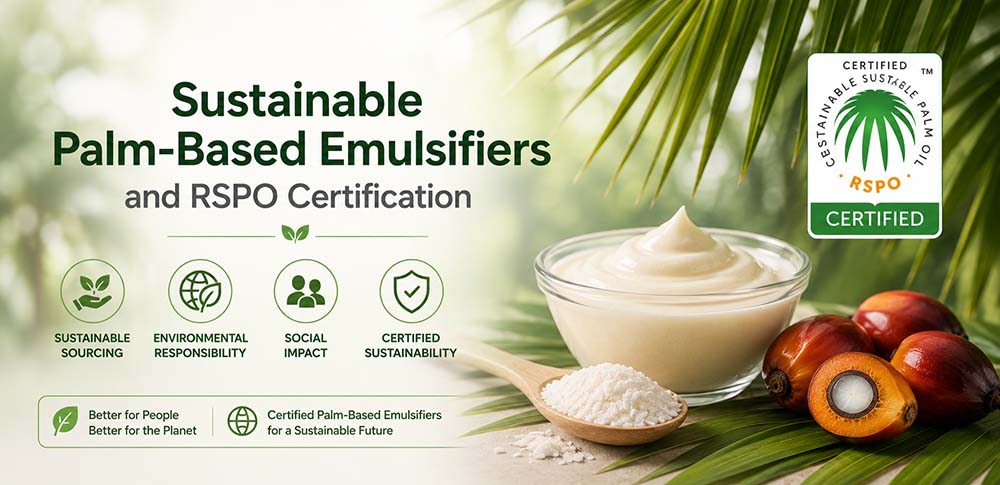
Palm-derived ingredients play an essential role in modern food manufacturing. From bakery products and whipping creams to confectionery and dairy alternatives, many widely used food emulsifiers such as Distilled Monoglycerides (DMG), DATEM, SSL, PGE, and PGPR are partially or entirely derived from palm oil fractions.
However, increasing global concerns about deforestation, biodiversity loss, and supply chain transparency have transformed the way food manufacturers evaluate their ingredient suppliers. Today, sustainability is no longer an optional marketing message—it has become a purchasing requirement.
This article explains what RSPO certification means, how it applies to palm-derived emulsifiers, what the different supply chain models actually guarantee, and what food manufacturers should reasonably require from their emulsifier suppliers.
Why Palm Oil Dominates Emulsifier Production?
Palm oil and palm kernel oil have physical and chemical properties that make them uniquely useful for emulsifier manufacturing:
Palm oil is rich in palmitic acid (C16:0) and oleic acid (C18:1) — fatty acids used in mono- and diglycerides, certain lecithin blends, and polyglycerol esters.
Palm kernel oil is rich in lauric acid (C12:0) and myristic acid (C14:0) — shorter-chain saturated fatty acids that produce emulsifiers with specific melting profiles valuable in confectionery, dairy, and whipping applications. Sorbitan esters (Span series) and hardened palm kernel fractions used in whipping cream powder formulations typically originate from palm kernel.
Beyond composition, palm yields significantly more oil per hectare than competing crops — roughly 4–10 times more than soybean, rapeseed, or sunflower. This yield efficiency means that replacing palm with alternative crops at current global consumption volumes would require substantially more agricultural land, not less.
The sustainability problem isn't that palm is the wrong crop. It's that rapid expansion of palm cultivation — particularly in Indonesia and Malaysia, which produce over 85% of the world's palm oil — has historically been associated with deforestation, peatland destruction, loss of biodiversity, and displacement of local communities. These consequences are real and documented, and they have driven regulatory, retailer, and consumer pressure across global supply chains.
What RSPO Is and What It Does?
The Roundtable on Sustainable Palm Oil (RSPO) is a multi-stakeholder nonprofit founded in 2004. Its members include palm oil producers, processors, consumer goods manufacturers, retailers, banks, and environmental and social NGOs. RSPO's primary function is to set and certify standards for sustainable palm oil production.
RSPO-certified producers must meet requirements covering:
# No deforestation: No clearing of primary forest or high conservation value (HCV) land for new palm plantations
# No new peatland development: Prohibition on draining or developing peat soils, which store enormous quantities of carbon
# Greenhouse gas emissions reduction: Certified producers must demonstrate emissions reduction plans
# Worker rights and welfare: Compliance with ILO labor standards, living wages, freedom of association
# Community rights: Free, prior, and informed consent (FPIC) from local communities before new development
# Traceability: Supply chain documentation from plantation to mill, and ideally beyond
RSPO certification requires independent third-party auditing. Certified producers, mills, and supply chain actors are audited annually. The RSPO trademark and certification number on a product or ingredient is not self-declared — it is issued by RSPO-approved certification bodies.
The Four RSPO Supply Chain Models
This is where most food manufacturers get confused — and where a lot of sustainability claims fall apart under scrutiny.
RSPO offers four different supply chain certification models. They are not equivalent. Understanding what each one actually guarantees determines whether your "sustainable" claim has substance.
1. Identity Preserved (IP)
What it guarantees: The certified sustainable palm oil comes from a single, identified RSPO-certified source and is kept physically separate from all other palm oil throughout the entire supply chain, from plantation to your receiving dock.
What it means in practice: You can trace the palm in your ingredient back to a specific certified plantation. This is the strongest claim. It's also the most expensive and logistically demanding.
Who uses it: Primarily specialty applications where full provenance traceability is a specific commercial requirement — some premium food brands, pharmaceutical applications.
2. Segregated (SG)
What it guarantees: RSPO-certified palm oil from multiple certified sources is kept physically separate from non-certified palm throughout the supply chain. The final ingredient contains only certified sustainable palm, but from potentially multiple certified sources rather than one identified plantation.
What it means in practice: Your ingredient is made from certified sustainable palm. You cannot trace it to a specific plantation, but you can confirm that every drop of palm in the ingredient came from a certified source.
Who uses it: Common choice for food manufacturers who want to make meaningful sustainability claims without the cost premium of IP. More widely available than IP.
3. Mass Balance (MB)
What it guarantees: Certified and non-certified palm oil are mixed in the supply chain, but the volume of certified palm oil purchased equals the volume of certified content in the final product. It's an accounting model — the math balances, but the physical palm in your ingredient may or may not be from a certified source.
What it means in practice: You are financially supporting certified sustainable palm production, but you cannot claim that the palm in your specific batch of ingredient is certified. The certification is at the supply chain level, not the physical product level.
Who uses it: The most commercially viable model for ingredients processed through complex refining and chemical modification steps — including many emulsifiers — where physical segregation is difficult or cost-prohibitive. Widely used across the industry.
The honest limitation: Mass balance enables supply chain investment in sustainable palm without the infrastructure cost of segregation, but it does not guarantee the physical content of any individual product. Critics argue this is insufficient; supporters argue it is the economically realistic path to scaling certified volumes.
4. Book and Claim (RSPO Credits / PalmTrace)
What it guarantees: Nothing about the physical palm in your ingredient. Instead, you purchase RSPO credits (trademarked as "RSPO Credits" on PalmTrace platform) that represent certified sustainable palm oil volumes produced by certified growers. The credits fund certified producers directly, independent of the supply chain.
What it means in practice: The palm in your ingredient may come from any source, certified or not. You have purchased credits equivalent to the volume of palm used, supporting certified producers financially.
Who uses it: Organizations that cannot access certified palm through their supply chain — or those at the beginning of a transition — but want to support certified production and offset non-certified volumes. Also used by brands in markets where certified supply is unavailable.
The honest limitation: Book and claim does not change the physical supply chain. It is a financial instrument. Using it while making product-level sustainability claims requires careful wording — claims about "supporting sustainable palm" are accurate; claims about "containing sustainable palm" are not.
How Certification Applies to Derived Emulsifiers
Here's the practical challenge for emulsifier supply chains: palm oil undergoes significant chemical transformation on its way to becoming GMS, DMG, SSL, or sorbitan esters.
The process: palm oil → fatty acid fractionation and hydrogenation → glycerolysis or esterification → distillation or purification → finished emulsifier
Each step involves heat, catalysts, chemical reagents, and physical separation. The starting material — palm oil or palm kernel oil — is chemically transformed into fatty acid derivatives that no longer resemble the original oil.
For Identity Preserved and Segregated certification, this transformation creates a physical traceability challenge: certifying bodies must confirm that certified palm oil (and not non-certified oil) entered the process at the beginning. This requires mill and refinery certification, mass balance tracking within processing facilities, and documentation of yields across each transformation step. It is achievable but requires supply chain infrastructure investment.
For Mass Balance certification, the accounting model is more tractable for complex derivative supply chains — certified volumes purchased are credited against derivative products sold, with transformation yields documented.
RSPO maintains a list of certified supply chain actors, including refineries and derivative processors, that have been audited and approved to handle certified volumes. When sourcing RSPO-certified emulsifiers, verify that the specific supplier — not just the palm oil producer — holds a current, valid supply chain certificate from an approved certification body.
What Retailers and Regulators Are Requiring
Sustainability requirements for palm-derived ingredients are tightening at both the regulatory and commercial levels.
EU Deforestation Regulation (EUDR): The EU Deforestation Regulation (Regulation 2023/1115), which entered into force in 2023, requires that palm oil and palm oil derivatives placed on the EU market after the regulation's full enforcement date must not be associated with deforestation occurring after December 31, 2020. It requires companies to conduct due diligence, provide geolocation data for production areas, and submit compliance statements. For emulsifier manufacturers selling into EU markets, this regulation applies to their palm-derived products regardless of RSPO status.
Major retailer requirements: Several global retailer groups — including Walmart, Tesco, Carrefour, and others — have published palm oil commitments requiring suppliers to source certified sustainable palm. These commitments vary in what they accept (IP/SG only, or MB and Book and Claim as well) and in their timelines, but the direction is consistent. Emulsifier suppliers selling to consumer goods companies that supply these retailers will face this requirement passed down through the supply chain.
Consumer goods companies: Unilever, Nestlé, Mondelēz, Mars, and many others have published No Deforestation, No Peatland, No Exploitation (NDPE) policies and RSPO sourcing commitments. These commitments directly affect which emulsifier suppliers they will approve.
The common thread: certification is moving from voluntary to expected for suppliers in major commercial supply chains, and the standard is gradually shifting from Mass Balance toward higher-integrity models (Segregated and Identity Preserved) for finished product claims.
What to Require from Your Emulsifier Supplier
When evaluating an emulsifier supplier's sustainability credentials, ask specifically:
1. Which RSPO supply chain model do you use? IP, SG, MB, or Book and Claim. The answer determines what you can honestly claim about your finished products.
2. Is your RSPO supply chain certificate current? RSPO certificates are issued annually by approved certification bodies. Ask for the certificate number and verify it on the RSPO PalmTrace database (available at rspo.org). An expired certificate or a certificate from an unapproved body is not valid.
3. Does your certificate cover the specific emulsifier product, or only your palm oil input? Supply chain certification must cover the entire processing chain from palm oil receipt through to the finished emulsifier. A supplier with only a palm oil sourcing certificate — without a derivative processing certificate — cannot make certified claims about their emulsifier products.
4. Can you provide RSPO-certified volumes for your GMS/DMG/SSL orders? If you need certified volumes for your own supply chain reporting, confirm the supplier can allocate certified product to your orders — not just certify that they source certified palm overall.
5. Are you compliant with EUDR due diligence requirements? For EU-market supply chains, EUDR compliance (geolocation data, due diligence statements) will be required. Ask whether the supplier's supply chain documentation supports EUDR compliance, or whether this is in development.
6. What non-RSPO sustainability commitments do you hold? RSPO is not the only framework. Some suppliers operate under POIG (Palm Oil Innovation Group) standards, NDPE supplier commitments, or Rainforest Alliance certification. Understand the full picture, not just the presence or absence of RSPO.
The Honest State of Palm Sustainability in Emulsifiers
RSPO certification represents genuine progress toward sustainable palm oil — but it is not a solved problem. The most common certification model in complex derivative supply chains (Mass Balance) does not guarantee the physical content of individual products. Certification rates among palm oil producers globally remain below 20% of total production. Supply chain transparency beyond the mill level is still limited in many cases.
At the same time, the alternative — avoiding palm entirely — creates its own sustainability challenges. Switching to soybean or rapeseed-based emulsifiers requires significantly more agricultural land for equivalent output, potentially shifting deforestation pressure to other regions. Palm's efficiency advantage is real.
The practical path forward for food manufacturers is not palm-free but palm-responsible: sourcing certified palm wherever supply chain models allow, participating in certification systems that fund credible improvement, and being accurate in how sustainability claims are communicated to customers and consumers.
CHEMSINO's Approach to Palm-Based Emulsifier Sustainability
CHEMSINO manufactures palm-derived emulsifiers — including GMS, DMG, SSL, and sorbitan esters — for food manufacturers across Asia, the Middle East, Europe, and beyond.
We recognize that our customers face increasing sustainability requirements from their own customers, retailers, and regulators. We are actively developing our RSPO supply chain certification capacity and can discuss certified sourcing options — including Mass Balance and Segregated supply — for customers with documented requirements.
If your company has a palm oil policy, RSPO sourcing commitment, or EUDR compliance requirement that affects your emulsifier purchasing decisions, we want to understand it and work with you on how our supply chain can support it.
Emulsifiers are our only business. That means sustainability in palm-derived emulsifier supply chains isn't a side topic for us — it's a core part of what we need to get right.

 Emulsifier List
 About Us