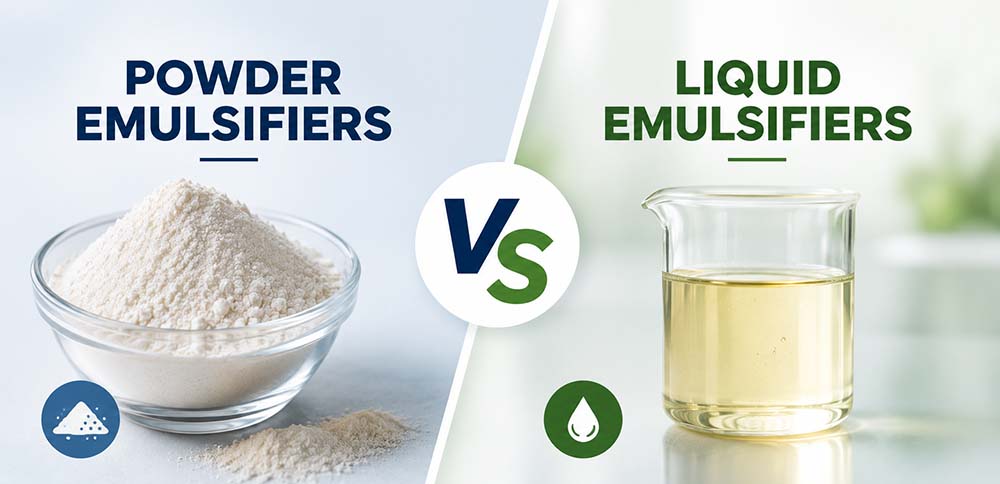
When selecting food emulsifiers, manufacturers usually focus on the emulsifier type itself—DMG, DATEM, PGPR, or Polysorbate. However, another important factor is often overlooked: the physical form of the emulsifier.
The same emulsifier can behave very differently depending on whether it is supplied as a powder or a liquid. For bakery manufacturers, a powdered emulsifier may improve handling and storage stability. For chocolate producers, liquid emulsifiers can significantly simplify processing and reduce production costs. Therefore, choosing between powder and liquid emulsifiers is not merely a packaging decision; it directly affects manufacturing efficiency, product quality, logistics costs, and even the final sensory characteristics of the food.
This article explores the technical differences between powder and liquid emulsifiers and provides practical guidance for food manufacturers.
Why the Same Emulsifier Can Come in Two Forms
An emulsifier's natural physical state is mainly determined by its fatty acid chain:
# Saturated fatty acids (stearic C18:0, palmitic C16:0) produce solid emulsifiers at room temperature — these appear as powder, flakes, or beads
# Unsaturated fatty acids (oleic C18:1) produce liquid or paste emulsifiers at room temperature
But chemistry isn't the only factor. Manufacturing processes can convert an emulsifier from one form to another:
# Spray drying converts liquid lecithin into free-flowing powder by atomizing it with a carrier (usually maltodextrin) and removing the moisture
# Molecular distillation produces DMG in flake or bead form from a crude liquid reaction mixture
# Hydration converts powder DMG into alpha-gel paste — a form with higher surface activity than either powder or standard liquid
The active molecule is the same in each case. The form determines how easy it is to handle, how quickly it works in a food system, and how long it stays stable on the shelf.
The Four Key Differences
1. Handling and Storage
Powder emulsifiers behave like any dry ingredient. They're free-flowing at ambient temperature, easy to weigh on a scale, and can be stored on a standard warehouse shelf with no temperature control. They move through dry ingredient hoppers and feeders without any special equipment.
Liquid emulsifiers vary widely in how easy they are to handle. Polysorbate 80 is a thin, pourable liquid at room temperature — relatively easy to work with. Standard liquid lecithin is a thick, sticky amber paste that flows slowly, clings to containers, and can be difficult to weigh accurately. PGPR is viscous and needs warming to pour cleanly. In a production facility, viscous liquid emulsifiers often require heated storage tanks, insulated transfer lines, and dedicated dosing pumps — infrastructure that adds capital and operating costs.
2. How Quickly They Disperse
Liquid emulsifiers disperse faster. When you add Polysorbate 80 to a cold aqueous system, it dissolves within seconds with moderate agitation. Liquid lecithin blends into chocolate mass at processing temperature without any activation step.
Powder emulsifiers need more time and energy to distribute evenly. GMS powder added directly to a bread dough needs sufficient mixing time to melt, spread, and reach the starch surfaces where it works. If mixing is insufficient, the emulsifier sits in pockets, and the finished product performs inconsistently. This is why DMG is often pre-hydrated into an alpha-gel paste before addition to dough — the paste form distributes much more evenly than dry powder.
3. Shelf Life and Stability
Powder emulsifiers generally have longer shelf life. The absence of water means hydrolysis — the chemical reaction where water breaks down ester bonds — doesn't occur. Most powder emulsifiers (GMS, SSL, powder lecithin) achieve 24-month shelf life under standard ambient conditions (below 25°C, below 65% relative humidity).
Liquid emulsifiers face greater stability challenges. Those based on unsaturated fatty acids — Polysorbate 80 (oleic acid chain), Span 80 (oleic acid), liquid lecithin (mixed phospholipids including unsaturated chains) — are susceptible to oxidation. The carbon-carbon double bond in the unsaturated chain is vulnerable to attack by oxygen, producing peroxides and eventually off-flavors. Peroxide value testing on incoming lots is standard practice for quality-conscious users of these materials.
Polysorbate 60 is more oxidatively stable than Polysorbate 80 because its stearic acid chain is fully saturated — which is one reason it's preferred over Polysorbate 80 in whipped toppings and baked goods with longer shelf lives.
4. Dry Mix Compatibility
This is non-negotiable: only powder emulsifiers work in dry blends. If you're making a premix, a dry bakery mix, or any product where ingredients are blended in dry form before use, liquid emulsifiers will cause clumping, uneven distribution, and reduced shelf life of the mix. There is no workaround. SSL powder in a bread mix, GMS in a cake mix, powder lecithin in a coffee creamer powder — these are standard. Liquid lecithin in the same applications is not viable.
Common Emulsifiers and Their Forms
| Emulsifier |
Typical Form |
Why |
| GMS (Glycerol Monostearate) |
Powder, flake, bead |
Stearic acid chain; solid at ambient |
| DMG (Distilled Monoglyceride) |
Powder, flake; also as alpha-gel paste |
High-purity monoglyceride; paste form for better dispersion |
| SSL (Sodium Stearoyl Lactylate) |
Powder, fine flake |
Pale cream solid; melts above 46°C |
| DATEM |
Powder or liquid |
Available in both; application-dependent |
| Polysorbate 60 |
Waxy solid/soft paste |
Stearic acid chain; softens around 25°C |
| Polysorbate 80 |
Amber viscous liquid |
Oleic acid chain; liquid at ambient |
| Lecithin (standard) |
Amber viscous liquid |
~60% phospholipids; sticky and slow-flowing |
| Lecithin (de-oiled / powder) |
Free-flowing powder |
~95–97% phospholipids; spray-dried |
| Span 80 (Sorbitan Monooleate) |
Amber liquid |
Oleic acid chain |
| Span 60 (Sorbitan Monostearate) |
Waxy solid |
Stearic acid chain |
| PGE (Polyglycerol Esters) |
Waxy solid, bead, or powder |
Stearate-based grades are solid |
| PGPR |
Amber viscous liquid |
Ricinoleic acid base; liquid but viscous |
Which Form to Use by Application
Bread and Rolls
Powder form: SSL and DMG
SSL is the most widely used dough strengthener in commercial bread. It comes as a fine powder that disperses into dough during mixing, strengthens gluten structure, and improves loaf volume and gas retention. DMG is the standard anti-staling emulsifier — it forms inclusion complexes with amylose starch that slow crumb firming over shelf life.
For best anti-staling performance, DMG should be used in alpha-gel form. The alpha-gel (made by heating DMG with water, then controlled cooling) is a paste that distributes evenly through dough and places the emulsifier in its most active crystal form before it even enters the mixer. Dry DMG powder works but is less efficient — it must melt and find the starch surface itself during mixing.
The standard commercial bread emulsifier system is SSL (0.25–0.5% flour basis) + DMG (0.3–0.5% flour basis), each in powder form.
Cakes and Muffins
Powder or fat-blended form: GMS, DMG, Polysorbate 60
Cake emulsifiers improve batter aeration (more air incorporated during mixing), produce finer crumb structure, and help retain moisture over shelf life. GMS and DMG are used as powders, sometimes pre-blended into shortening before batter preparation for better fat distribution. Polysorbate 60, a waxy solid at room temperature, is typically melted into fat before use. The combination of Polysorbate 60 and GMS is common in commercial layer cakes.
Chocolate and Compound Coatings
Liquid form: Lecithin, PGPR
Liquid lecithin reduces chocolate viscosity during conching and coating — it disperses into the chocolate mass at 45–55°C processing temperature. PGPR (fully liquid) is used specifically to reduce yield value (the force needed to start chocolate flowing), which makes it easier to achieve thin, even enrobing. Both liquid emulsifiers are standard; powder lecithin is available but less common in chocolate production because the liquid form disperses more readily into the fat-continuous chocolate mass.
Typical usage: lecithin 0.2–0.5% + PGPR 0.1–0.2% in compound coatings. Lecithin alone up to 0.5% in real chocolate.
Ice Cream
Both forms, added at different stages
Ice cream emulsifier systems combine two types of ingredients that are added at different points in the process:
# GMS or DMG powder is added to the warm mix (65–72°C) during pasteurization. At this temperature, the powder melts and disperses into the fat phase easily.
# Polysorbate 80 (liquid) is added at or after homogenization — it dissolves in the mix without heating and helps control fat partial coalescence during freezing.
Together, the monoglyceride (which destabilizes fat globules) and the polysorbate (which stabilizes air cells) produce ice cream with firm texture, controlled meltdown, and consistent overrun.
Salad Dressings and Sauces
Liquid form: Polysorbate 80, liquid lecithin
Cold-process dressings — produced at ambient temperature without heating — need emulsifiers that work cold. Polysorbate 80 dissolves in cold water and stabilizes oil droplets in vinaigrettes and reduced-egg dressings. Liquid lecithin works in oil-continuous systems. Powder emulsifiers are impractical in low-viscosity cold liquid applications because they don't disperse without heat or high-shear mixing.
Beverage Emulsions and Flavor Systems
Liquid form: Polysorbate 80
Solubilizing oil-soluble flavors, fat-soluble vitamins (A, D, E, K), and nutraceuticals into water-based beverages requires an emulsifier that dissolves at ambient temperature and produces a clear or near-clear solution. Polysorbate 80, at 0.05–0.2%, does this effectively. Powder emulsifiers don't work in this application — they don't dissolve in water without heat, and they typically produce cloudy solutions.
Dry Mixes and Premixes
Powder form only
SSL powder in dry bread mix. GMS powder in instant cake mix. Powder lecithin in coffee creamer powder. There is no liquid alternative for dry blend applications. Any liquid emulsifier added to a dry mix will cause the powder to clump, distribute unevenly, and degrade faster due to moisture introduction.
Switching Between Powder and Liquid: What to Recalculate
If you're switching from one form to another, the active ingredient content is often different:
Lecithin: Standard liquid lecithin contains approximately 60% phospholipids. De-oiled powder lecithin contains 95–97% phospholipids. Using the same weight of powder as liquid delivers roughly 60% more active phospholipid — which is likely more than you want. Recalculate on a phospholipid basis, not total weight.
DMG: Powder DMG and alpha-gel DMG contain the same monoglyceride content by weight (both are high-purity, ≥ 90%), but alpha-gel DMG is in an immediately active crystal form that distributes more evenly in dough. Switching from powder to alpha-gel at the same weight typically improves anti-staling performance without changing dosage.
Polysorbate 60 vs. Polysorbate 80: These are different molecules — same HLB (about 14.9 vs. 15.0), but different fatty acids (stearic vs. oleic). Switching between them is not a form change; it's a product change that affects oxidative stability and interfacial behavior.
Frequently Asked Questions
Can powder lecithin replace liquid lecithin at the same weight? No. De-oiled powder lecithin has approximately 95–97% phospholipids versus 60% in liquid. You'd be adding significantly more active ingredient. Calculate the equivalent dose based on phospholipid content — roughly 0.6–0.65g of powder lecithin for every 1g of liquid lecithin.
Does physical form affect regulatory approval? No. Powder lecithin and liquid lecithin are the same regulated substance (E322 in the EU; GRAS under 21 CFR 184.1400 in the US). Physical form doesn't affect the additive designation or permitted use levels. Maximum use levels apply to the active chemical, not the total weight of the form used.
Is alpha-gel DMG a powder or a liquid? Neither — it's a paste. Alpha-gel DMG is made by heating high-purity DMG with water and cooling under controlled conditions to produce a lamellar gel structure. It behaves like a soft paste at room temperature. It's more effective than dry DMG powder in bread applications because the emulsifier is already in its active crystal form before entering the mixer.
Which form has better shelf life? Powder generally wins, for two reasons: absence of water prevents hydrolysis, and solid-state oxidation is slower. The exception: liquid emulsifiers based on saturated fatty acids (Polysorbate 60, Span 60) are more stable than those based on unsaturated fatty acids (Polysorbate 80, Span 80, liquid lecithin). Among liquid emulsifiers, saturated-chain grades oxidize more slowly.
Quick Reference
| If you need... |
Powder |
Liquid |
| Dry blend/premix |
✓ Only option |
✗ |
| Cold-process liquid systems |
✗ |
✓ |
| Long shelf life |
✓ Generally better |
Depends on saturation |
| Chocolate or coating production |
Possible |
✓ Standard |
| Beverage emulsification |
✗ |
✓ |
| Bread dough (anti-staling) |
✓ (alpha-gel paste preferred) |
— |
| Ice cream mix |
✓ (warm stage) |
✓ (cold stage) |
| Simple ambient storage |
✓ |
Depends on viscosity |
CHEMSINO: Emulsifiers in the Form Your Application Needs
CHEMSINO supplies food-grade emulsifiers in both powder and liquid forms — GMS, DMG (powder, flake, and alpha-gel), SSL, sorbitan esters (Span 60, Span 80), polysorbates (Polysorbate 60, Polysorbate 80), and lecithin-based products.
Because emulsifiers are our only category, our team works with form selection questions across the full range of applications described above. Whether you're building a bread formula and deciding between dry SSL and liquid DATEM, or reformulating a chocolate coating and switching from liquid to powder lecithin, we can help you understand what changes and what to adjust.
Every batch ships with a full CoA. Samples in specific physical forms are available before a purchase commitment.

 Emulsifier List
 About Us