Distilled monoglyceride (DMG) and standard glycerol monostearate (GMS) share the same regulatory label — "mono- and diglycerides of fatty acids" — and often appear as interchangeable options on supplier catalogs.
In a bakery formulation, they behave very differently. The gap shows up in crumb firmness measurements at day 7, in whipped topping stability tests, and in shelf life data — not on the CoA reviewed at receiving.
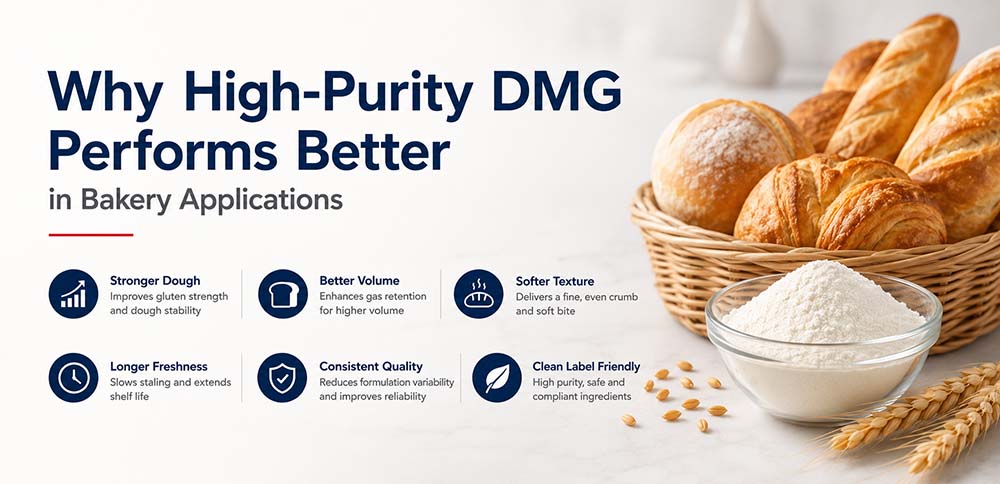
This article explains the four mechanisms behind that performance gap, what to look for on a DMG specification, and how purity affects dosage decisions.
What Is High-Purity DMG? How Does It Differ from Standard GMS?
Both products start the same way: glycerol reacts with fatty acids (typically stearic acid, C18:0) to produce a crude mixture of mono-, di-, and triglycerides.
Standard GMS is that mixture, sometimes partially purified:
# Monoglycerides: 40–60%
# Diglycerides: 30–45%
# Triglycerides: 5–10%
# Free glycerol and fatty acids: remainder
High-purity DMG goes through molecular distillation — separation under high vacuum by vapor pressure difference. The monoglyceride fraction is isolated:
# Monoglycerides: 90–95%+
# Diglycerides: < 5%
# Triglycerides: < 1%
The diglycerides in standard GMS are not passive. They compete with monoglycerides at functional interfaces, disrupt crystal structure, and reduce emulsification efficiency. This interference — not just the lower monoglyceride content — explains most of the performance difference between the two grades.
Mechanism 1: Starch Complexation and Anti-Staling in Bread
The core function: Monoglycerides slow bread staling by forming inclusion complexes with amylose — the straight-chain component of starch.
During baking, starch granules gelatinize, and amylose chains unwind. During cooling and storage, these chains recrystallize through retrogradation — the primary mechanism of bread staling that converts a soft crumb to a firm, dry one.
Monoglycerides interrupt retrogradation by inserting their fatty acid chains into the hydrophobic interior of amylose helices, stabilizing them in a complexed state that resists recrystallization. More complexation means a measurably softer crumb for longer.
Why Purity Changes the Outcome
Diglycerides cannot form amylose inclusion complexes. The two fatty acid chains create steric interference that prevents helix insertion. Worse, diglycerides compete for the same starch interface without contributing any functional benefit — and can disrupt already-formed monoglyceride-amylose complexes.
In a standard GMS at 50% monoglyceride content, roughly half the added "emulsifier" is diglycerides that actively work against starch complexation.
The numbers: To match the starch complexation delivered by 0.3% high-purity DMG (90% MG, providing 0.27% active monoglyceride), standard GMS at 50% MG requires approximately 0.54% addition. Even then, the diglyceride interference effect means equivalent performance is not guaranteed.
How to Measure the Difference
Texture Profile Analysis (TPA) quantifies crumb firmness in Newtons at day 1, 3, and 7 post-baking. The gap between high-purity DMG and standard GMS widens across the measurement period as the diglyceride interference accumulates. X-ray diffraction can confirm amylose complexation directly — higher V-amylose complex peak intensity confirms more effective monoglyceride incorporation into starch structure.
Mechanism 2: Alpha-Crystal Form and Alpha-Gel Functionality
The core principle: Monoglycerides exist in three crystal forms with very different surface activities. Only the alpha (α) form is functionally effective in most bakery applications. Only high-purity DMG can be reliably converted to and held in the alpha form.
The Three Crystal Forms
| Crystal Form |
Stability |
Surface Activity |
Bakery Function |
| Alpha (α) |
Metastable |
Highest |
Starch complexation, aeration, emulsification |
| Beta-prime (β') |
Intermediate |
Moderate |
Limited |
| Beta (β) |
Most stable |
Lowest |
Essentially inert |
Standard GMS as received is typically in the beta or beta-prime form — the thermodynamically stable states that result from cooling after production. These forms have low surface activity and poor functional performance in bakery systems.
High-purity DMG can be converted to the alpha form through a defined hydration process.
Alpha-Gel Preparation: The Standard Method
For maximum effectiveness, high-purity DMG is hydrated to produce an alpha-gel — a lamellar liquid-crystalline structure where monoglyceride bilayers alternate with water layers. This structure is highly surface-active and distributes readily through dough.
Process:
# Heat DMG above its melting point (70–80°C for stearate-based grades)
# Add water at the same temperature at a defined ratio (typically 1:1 to 1:2 DMG: water)
# Cool rapidly to below 50°C under agitation
# Hold at 30–40°C until the alpha gel sets
The alpha-gel can then be added directly to the mixer at the dough stage.
Why standard GMS fails here: The diglyceride fraction disrupts lamellar ordering in the gel structure. The resulting gel is unstable and rapidly reverts to the beta form. This is a chemical consequence of purity — not a processing problem that can be overcome with technique.
Dry vs. Alpha-Gel Addition
Dry DMG powder added directly to dough must melt, migrate to starch surfaces, and recrystallize in the correct form during mixing — a sequence that is less reliable and less efficient than pre-prepared alpha-gel. Bakeries that switch from dry to alpha-gel DMG addition typically observe improved and more consistent anti-staling performance without any formula change.
Commercial suppliers often provide DMG in pre-hydrated alpha-gel form (also called hydrated monoglyceride), which eliminates the on-site preparation step.
Mechanism 3: Fat Emulsification in Enriched Doughs and Cake Batters
The application: Brioche, sweet rolls, Danish pastries, layer cakes — high-fat bakery products where uniform fat distribution through the dough or batter matrix determines crumb structure and volume.
Monoglycerides position at the fat-water interface, lower interfacial tension, and stabilize fat droplets in the aqueous system. Uniformly distributed fat produces finer crumb structure, better oven spring, and improved moisture retention in the finished product.
Why Purity Determines Fat Distribution
At the fat-water interface, monoglycerides and diglycerides compete for adsorption space. Monoglycerides — one hydroxyl group, one acyl chain — adopt a more effective orientation at the interface than diglycerides, which carry two acyl chains that create steric crowding and interfacial disorder.
In standard GMS, the diglyceride fraction occupies interfacial area without providing equivalent stabilization. The result is a less ordered interfacial film, larger average fat droplet size, and more uneven fat distribution — translating to coarser crumb and reduced loaf volume.
High-purity DMG produces a denser, more organized monolayer at the fat-water interface: smaller fat droplets, finer crumb, and consistent volume development batch to batch.
Mechanism 4: Balance in the DMG + SSL Combination System
In commercial bread, DMG is almost never used alone. The standard emulsifier system is DMG + SSL (Sodium Stearoyl Lactylate) — a combination so ubiquitous it appears in virtually every commercial sandwich bread formula.
The two emulsifiers address different structural systems:
# SSL acts on gluten — strengthening the protein network, improving gas retention, increasing loaf volume
# DMG acts on starch — forming amylose complexes, retarding retrogradation, maintaining crumb softness
Together, they address both primary determinants of bread quality: volume and softness over shelf life.
What Happens When Standard GMS Replaces High-Purity DMG
When standard GMS substitutes for high-purity DMG at equivalent weight in a DMG + SSL system:
# SSL continues to deliver full gluten strengthening → good initial volume
# Reduced monoglyceride content delivers less starch complexation → faster staling
# The system produces bread with good opening-day quality that falls off significantly faster than specified
Increasing GMS dosage to compensate disrupts the formula cost structure and can introduce off-flavors from excess diglycerides. The combination system is designed around specific active monoglyceride content, not total "emulsifier" weight. Substituting grade without recalculating active MG content is one of the most common sources of unexplained shelf life underperformance in commercial bread lines.
What High-Purity DMG Looks Like on a CoA?
| Parameter |
High-Purity DMG |
Standard GMS |
| Monoglyceride content |
≥ 90% |
40–60% |
| Diglyceride content |
≤ 7% |
25–45% |
| Free glycerol |
≤ 1% |
≤ 4% |
| Acid value |
≤ 3 mg KOH/g |
≤ 6 mg KOH/g |
| Saponification value |
158–177 mg KOH/g |
158–177 mg KOH/g |
| Iodine value |
≤ 3 g I₂/100g |
≤ 3 g I₂/100g |
| Moisture |
≤ 1.0% |
≤ 2.0% |
| Melting point |
58–72°C |
55–70°C |
| Color (Gardner) |
≤ 4 |
≤ 6 |
The defining parameter is monoglyceride content. A product labeled "DMG" or "Distilled Monoglyceride" with less than 85% monoglycerides is not performing to distilled-grade standard, regardless of the label.
Require lot-specific actual test results — not specification ranges — for monoglyceride content on every incoming shipment. A supplier providing only ranges, not results, is signaling the limits of their quality control.
Dosage Conversion: Standard GMS to High-Purity DMG
If your formula specifies active monoglyceride content (as it should), here is what each grade requires to deliver the same functional dose:
| Grade |
Monoglyceride Content |
Addition Needed for 0.3% Active MG (flour basis) |
| High-purity DMG |
92% |
0.33% |
| Mid-grade GMS |
70% |
0.43% |
| Standard GMS |
50% |
0.60% |
| Low-grade GMS |
40% |
0.75% |
Using standard GMS at 0.3% addition delivers only 0.15% active monoglyceride — half the functional dose. This is the most common explanation for why bakeries that switch emulsifier supplier without adjusting dosage see unexplained shelf life decline.
Frequently Asked Questions
Can I substitute standard GMS for high-purity DMG at the same dosage? Not at equivalent weight. You need to recalculate based on active monoglyceride content. Even then, the diglyceride interference effect means performance equivalence is not guaranteed — particularly for anti-staling in bread.
Does high-purity DMG work better than standard GMS for cakes? Yes, for the same reasons: better fat distribution, finer crumb, and more consistent volume. The difference is more pronounced in bread (starch complexation mechanism) than in cake, but both benefit from higher monoglyceride purity.
What is the shelf life of high-purity DMG? Typically 24 months from production under cool (< 25°C), dry (< 65% RH) storage in sealed original packaging. Moisture is the primary driver of degradation — elevated moisture accelerates the hydrolysis of ester bonds and increases the acid value.
What does "alpha-gel DMG" mean in a supplier catalog? It means the DMG has been pre-hydrated to produce the alpha crystal form, ready for direct mixer addition. This eliminates the on-site preparation step and typically delivers more consistent performance than dry DMG addition.
Regulatory Status
Both high-purity DMG and standard GMS fall under the same regulatory designations in all major markets:
| Market |
Designation |
Reference |
| USA |
Mono- and diglycerides (GRAS) |
21 CFR 184.1505 |
| EU |
E471 |
Regulation (EC) No 1333/2008 |
| International |
ADI "not specified" |
JECFA (WHO/FAO) |
No regulatory distinction exists between grades. Both appear as "mono- and diglycerides of fatty acids" on ingredient labels. The performance difference is invisible to regulators and consumers — but fully measurable in texture data and shelf life results.
Working with CHEMSINO on High-Purity DMG
CHEMSINO manufactures distilled monoglycerides at ≥ 90% monoglyceride content for commercial bakery, dairy, and confectionery applications. Emulsifiers are our only category — not a product line within a broader ingredient portfolio. That focus means our technical team works with DMG across the full range of bakery applications described in this article, every day.
We supply high-purity DMG in dry powder and flake form. Alpha-gel preparation guidance is available for customers requiring hydrated monoglyceride for direct mixer addition. Every batch ships with a full CoA including actual monoglyceride content by GC assay — not specification ranges.
If you're evaluating a switch from standard GMS to high-purity DMG, troubleshooting shelf-life inconsistencies, or recalculating dosage after a grade change, our technical team can provide data and formulation support.

 Emulsifier List
 About Us