Ice cream texture is built on air. The overrun — the volume of air incorporated during freezing — determines whether a scoop is light and creamy or dense and heavy. Getting air in is relatively straightforward. Keeping it stable, evenly distributed, and locked in place throughout production, distribution, and scooping is where the emulsifier system does its work.
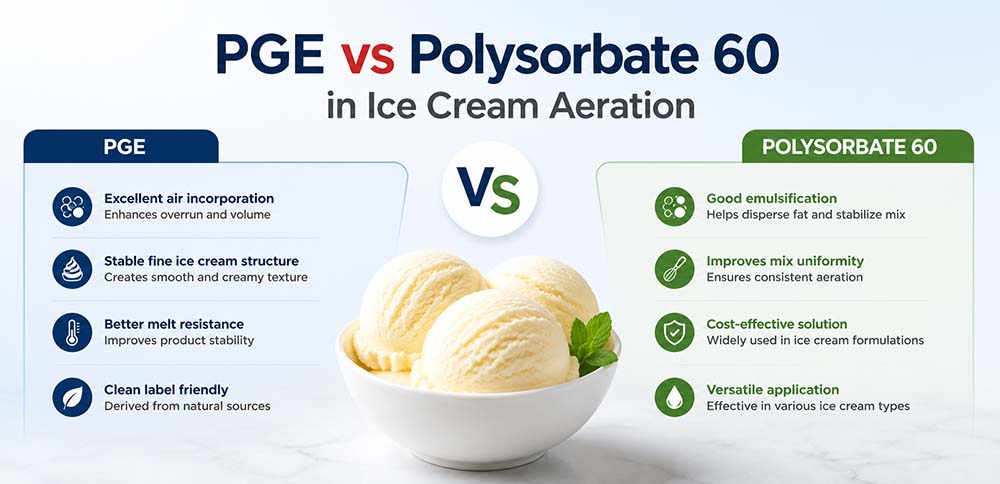
Two emulsifiers appear most often in ice cream aeration applications: Polyglycerol Esters of Fatty Acids (PGE) and Polysorbate 60. They address the same problem through different mechanisms, perform differently under varying processing conditions, and are rarely direct substitutes for one another.
This article explains the chemistry behind each, how they affect aeration and texture, and how to decide which one — or which combination — belongs in your formulation.
What Each Emulsifier Actually Does in Ice Cream
Before comparing PGE and Polysorbate 60, it helps to understand what ice cream aeration actually requires from an emulsifier.
During freezing and simultaneous agitation in a continuous freezer, two things must happen in sequence:
# Air incorporation: Air bubbles must be introduced and stabilized against immediate coalescence. The emulsifier lowers interfacial tension at the air-water interface, making it easier to subdivide bubbles and maintain them.
# Fat partial coalescence: Fat globules must lose some of their natural protective membrane and aggregate — partially, not completely — around air bubbles. This fat network is what gives ice cream its body, its resistance to rapid melting, and its textural firmness. Too little coalescence and the ice cream is wet and heavy; too much and it becomes buttery.
These two functions — air stabilization and fat destabilization — are in tension. An emulsifier that stabilizes interfaces too strongly prevents the fat destabilization necessary for texture. One that promotes fat coalescence too aggressively produces a buttery, grainy texture.
PGE and Polysorbate 60 address this balance differently.
PGE: Polyglycerol Esters of Fatty Acids
Chemistry
Polyglycerol Esters of Fatty Acids (PGE) is produced by esterifying polymerized glycerol (typically diglycerol, triglycerol, or higher) with fatty acids — most commonly stearic acid (C18:0) or mixed saturated fatty acids from palm or palm kernel oil. The degree of polymerization and the fatty acid chain both affect HLB and functional behavior.
Commercial PGE for ice cream applications typically has an HLB of 5–7, placing it in the W/O emulsifier range. It is a pale waxy solid with a melting point of 55–65°C.
EU designation: E475. FDA: 21 CFR 172.854.
How PGE Works in Ice Cream
PGE's primary function in ice cream is promoting fat partial coalescence — the controlled aggregation of fat globules that builds the fat network around air bubbles.
PGE is highly surface-active at the fat-water interface. It displaces the native milk protein membrane from fat globule surfaces — primarily the casein and whey protein layer that naturally protects fat globules and keeps them discrete. By weakening this protective layer, PGE makes fat globules more prone to partial coalescence when they collide during freezing agitation.
The result is a well-developed fat network that:
# Anchors air bubbles firmly in place
# Gives ice cream a dry, firm texture that holds shape well during scooping
# Reduces meltdown rate
# Produces a clean, non-greasy mouthfeel when the fat network is well-controlled
PGE is particularly effective in formulations with higher fat content (≥ 10%) and in continuous freezers that apply sufficient shear to promote fat globule collisions. It is less effective in low-fat ice cream, where there is insufficient fat to build a robust network.
Typical Usage Level
0.1–0.3% of mix weight. PGE is potent — excessive use produces over-destabilized fat, resulting in buttery texture and fat separation visible as greasiness on the scoop surface.

Polysorbate 60: Polyoxyethylene (20) Sorbitan Monostearate
Chemistry
Polysorbate 60 is produced by ethoxylating sorbitan monostearate with 20 moles of ethylene oxide. The stearic acid (C18:0) fatty acid chain is saturated, and the polyethylene glycol chains give the molecule strong hydrophilicity — HLB 14.9, firmly in the O/W emulsifier range. It is an amber waxy solid at room temperature.
EU designation: E435. FDA: 21 CFR 172.836.
How Polysorbate 60 Works in Ice Cream
Polysorbate 60's primary function is air stabilization — improving the incorporation and retention of air bubbles during the freezing process.
At HLB 14.9, Polysorbate 60 is water-soluble and migrates to the air-water interface rather than the fat-water interface. It lowers surface tension, reduces the energy required to subdivide air bubbles, and forms a stabilizing film around air cells that resists coalescence.
Polysorbate 60 also has a secondary effect on fat partial coalescence — it competes with milk proteins at the fat globule surface and can partially displace them, but this effect is weaker and less targeted than PGE's displacement mechanism. Its main contribution is on the air side of the air-fat-water system.
The practical result of Polysorbate 60 in ice cream:
# Faster and more complete air incorporation during freezing
# More uniform, finer air cell distribution
# Better overrun achievement at a given fat content
# Improved texture uniformity between batches
# Slightly lower firmness compared to PGE at equivalent dosage
Why Polysorbate 60 Rather Than Polysorbate 80?
In ice cream, Polysorbate 60 is generally preferred over Polysorbate 80 despite near-identical HLB values (14.9 vs 15.0). The difference is the fatty acid chain: Polysorbate 60 uses saturated stearic acid, while Polysorbate 80 uses monounsaturated oleic acid.
The saturated chain in Polysorbate 60 forms a more rigid, ordered interfacial film at the air-water interface at ice cream temperatures (−5 to −8°C during continuous freezing). This rigidity produces more stable air cells and contributes to better texture over the product's shelf life. Polysorbate 80's unsaturated chain is more fluid at these temperatures, producing a softer interfacial film that is slightly less stable — an advantage in whipped toppings (where rigid structure isn't needed) but a disadvantage in ice cream.
Typical Usage Level
0.05–0.2% of mix weight. Polysorbate 60 is effective at lower levels than PGE due to its high water solubility and rapid migration to interfaces during processing.
Direct Comparison
| Property |
PGE |
Polysorbate 60 |
| Chemical basis |
Polyglycerol fatty acid ester |
Ethoxylated sorbitan monostearate |
| Fatty acid |
Stearic/mixed saturated |
Stearic acid (C18:0) |
| HLB value |
5–7 |
14.9 |
| Physical state |
Waxy solid |
Waxy solid / paste |
| Primary interface |
Fat-water |
Waxy solid / paste |
| Primary function |
Fat partial coalescence |
Air stabilization and overrun |
| Effect on texture |
Firmer, drier, better shape retention |
Finer air cells, improved overrun |
| Effect on melt resistance |
Strong positive effect |
Moderate positive effect |
| Effectiveness in low-fat |
Limited |
More effective than PGE |
| Sensitivity to overdose |
High (buttery texture) |
Moderate |
| Typical use level |
0.1–0.3% |
0.05–0.2% |
| EU designation |
E475 |
E435 |
| FDA reference |
21 CFR 172.854 |
21 CFR 172.836 |
Why Most Ice Cream Uses Both?
In commercial ice cream, PGE and Polysorbate 60 are almost always used together — not because one is insufficient, but because they address different parts of the same problem.
PGE promotes fat partial coalescence — building the fat network that gives ice cream its body and melt resistance. Polysorbate 60 stabilizes air cells — improving overrun and air distribution. Together, they produce an ice cream with better texture, more consistent overrun, better melt resistance, and improved structural stability than either achieves alone.
The combination also provides a useful degree of formulation flexibility. The ratio between PGE and Polysorbate 60 can be adjusted to shift the balance between firmness and lightness:
# Higher PGE ratio: Firmer texture, better shape retention, lower overrun. Suited for premium scooping ice cream displayed at ambient temperature.
# Higher Polysorbate 60 ratio: Higher overrun, lighter texture, faster air incorporation. Suited for soft-serve, light ice cream, or high-overrun economy products.
This combination system is typically used alongside mono- and diglycerides (GMS or DMG), which provide additional fat surface control and contribute to slower meltdown. The three-component system — GMS/DMG + PGE + Polysorbate 60 — is standard in commercial continuous-freezer ice cream production.
Application Scenarios
Premium Scooping Ice Cream (≥ 10% fat, high-quality dairy)
Recommended system: PGE 0.1–0.2% + Polysorbate 60 0.05–0.1% + DMG 0.1–0.15%
High-fat ice cream benefits most from PGE's fat network-building effect. The fat content provides sufficient substrate for robust partial coalescence. DMG controls the rate of coalescence and prevents over-destabilization. Polysorbate 60 supports air cell uniformity. Total emulsifier level: 0.25–0.45%.
Economy Ice Cream (6–8% fat, partial dairy replacement)
Recommended system: Polysorbate 60 0.1–0.2% + GMS 0.1–0.2%, with optional PGE 0.05–0.1%
Lower fat content limits PGE's effectiveness. Polysorbate 60 takes a larger role in air stabilization. GMS or DMG provides fat surface control. Total emulsifier level: 0.2–0.4%.
Low-Fat Frozen Dessert (< 5% fat)
Recommended system: Polysorbate 60 0.1–0.2% + stabilizer system (carrageenan, locust bean gum, guar gum)
At very low fat content, fat partial coalescence is insufficient to build meaningful structure. The primary structural mechanism shifts to the hydrocolloid stabilizer system. Polysorbate 60 supports air incorporation; PGE contributes little at this fat level and is often omitted.
Soft Serve
Recommended system: Polysorbate 60 0.05–0.15% + GMS 0.1–0.15%
Soft serve requires rapid overrun during drawing at higher temperatures (−4 to −6°C vs. −8 to −10°C for hardpack). Polysorbate 60's efficient air stabilization is well-suited to this. PGE can produce excessive fat destabilization at soft-serve drawing temperatures.
Processing Considerations
Pasteurization: Both PGE and Polysorbate 60 are stable at standard HTST (72°C for 15 seconds) and UHT (135°C for 2–4 seconds) pasteurization conditions. Neither requires special handling during heat treatment.
Homogenization: Both emulsifiers adsorb to fat globule surfaces during homogenization, partially displacing native milk proteins. This preconditions fat globules for partial coalescence during freezing. Two-stage homogenization (first stage 10–15 MPa, second stage 3–4 MPa) is standard and compatible with both emulsifiers.
Aging: The mix should be aged at 4°C for 4–24 hours before freezing. Aging allows emulsifiers to fully equilibrate at fat globule surfaces and fat to complete its crystallization — both of which are necessary for effective partial coalescence during freezing. Reducing aging time below 4 hours typically degrades texture regardless of emulsifier selection.
Continuous freezer conditions: Freezer barrel temperature, draw temperature, and dasher speed all affect the extent of fat partial coalescence. PGE's fat destabilization is more sensitive to these parameters than Polysorbate 60's air stabilization effect. If batch-to-batch texture variation is occurring despite consistent formulation, freezer conditions should be investigated alongside emulsifier dosage.
Regulatory Status
| Regulation |
PGE |
Polysorbate 60 |
| USA (FDA) |
21 CFR 172.854 |
21 CFR 172.836 |
| EU food additive |
E475 |
E435 |
| JECFA (WHO/FAO) |
ADI established |
ADI established |
| Typical ice cream limit (EU) |
5,000 mg/kg |
1,000 mg/kg |
Note that EU maximum permitted levels differ significantly between the two: PGE has a higher permitted level (5,000 mg/kg) in ice cream than Polysorbate 60 (1,000 mg/kg). At typical commercial usage levels, both remain well within limits, but formulations operating near the high end of the Polysorbate 60 range should verify compliance against the applicable food category limit.
Diagnosing Common Ice Cream Texture Problems
| Problem |
More Likely Cause |
Adjustment |
| Low overrun, dense texture |
Insufficient air stabilization |
Increase Polysorbate 60; check aging and freezer conditions |
| Wet, heavy texture (no dryness) |
Insufficient fat partial coalescence |
Increase PGE or DMG dosage |
| Buttery or greasy texture |
Over-destabilized fat |
Reduce PGE; check homogenization pressure |
| Poor melt resistance |
Weak fat network |
Increase PGE + DMG; verify fat content and type |
| Large, uneven air cells |
Poor air incorporation |
Increase Polysorbate 60; check mix viscosity and freezer speed |
| Texture inconsistency from batch to batch |
Emulsifier lot variability or freezer drift |
Audit emulsifier CoA; check barrel temperature and draw temp |
Sourcing PGE and Polysorbate 60
PGE and Polysorbate 60 are available from multiple suppliers, but product quality varies in ways that aren't always visible on a standard CoA. For PGE, the degree of glycerol polymerization and the fatty acid profile both affect HLB and functional performance — and both can vary between lots if manufacturing controls aren't consistent. For Polysorbate 60, fatty acid composition, residual polyethylene glycol content, and peroxide value all affect interfacial performance and oxidative stability.
CHEMSINO has supplied emulsifiers — including PGE, Polysorbate 60, GMS, and DMG — to ice cream manufacturers across Asia, the Middle East, and Europe for over a decade. Emulsifiers are our only business. That means our technical team works with ice cream emulsifier systems every day — not occasionally — and can help with emulsifier selection, dosage optimization, and troubleshooting texture or overrun inconsistency traced to the emulsifier system.
Every batch ships with a full Certificate of Analysis covering fatty acid profile, HLB, acid value, saponification value, peroxide value, and moisture. Samples and technical datasheets are available before any purchase commitment.

 Emulsifier List
 About Us