Home
Products
Emulsifier List
Application
Gallery
News
Blog
About Us
About Us
Contact Us
Your Position : Home > Blog

Food Emulsifiers in Pasta (Italian Pasta) Production

Date:2026-03-25
Read:
Share:
Italian pasta—whether spaghetti, penne, tagliatelle, or lasagne sheets—is based on a simple formula: durum wheat semolina and water, sometimes with egg. This simplicity works well in small batches. But at industrial scale, it often leads to practical issues: dough that is difficult to extrude consistently, pasta that sticks after cooking, and fresh products that lose softness within days.

This is where emulsifiers make a real difference. They don’t change the identity of pasta; they help control how it behaves during processing and storage. This blog breaks down how emulsifiers work in pasta production, which types are most useful, and how their role changes across dried, fresh, and egg pasta.


The Core Challenges Emulsifiers Solve in Pasta


Durum semolina dough is dense and relatively low in moisture, usually around 28–32%. It contains almost no fat and very limited natural emulsifying capacity. Unlike bread dough, there’s no built-in system to stabilize interactions between starch and protein.

In practice, three common issues appear:


Post-cook stickiness


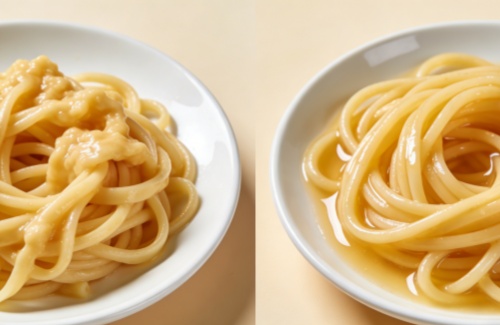
When pasta cooks, surface starch gelatinizes and becomes sticky. Strands easily clump together—something consumers notice, but foodservice operations feel even more strongly. Emulsifiers help by forming complexes with amylose (the linear part of starch), creating a barrier that reduces surface adhesion. The result is pasta that separates more easily after cooking.

Clumped Pasta vs Pasta with an Appropriate Amount of Emulsifier


Weak dough structure during extrusion


In high-speed production, dough is pushed through dies under pressure to form different shapes. If the structure is uneven, defects appear—cracks, rough surfaces, or inconsistent thickness. Emulsifiers that interact with gluten proteins improve cohesion and make the dough more tolerant to processing stress. From experience, even small adjustments here can noticeably improve line stability.
 

Staling in fresh and refrigerated pasta


Fresh pasta stales quickly due to starch retrogradation—basically, starch molecules reorganize and firm up over time. This leads to a dry, firm texture even before the labeled shelf life ends. Emulsifiers slow this process by interfering with amylose recrystallization, helping pasta stay softer during storage.
 

Commonly Used Emulsifiers in Italian Pasta


Distilled Monoglycerides (DMG, a type of E471)


DMG is one of the most widely used emulsifiers in pasta production. It forms complexes with amylose, which helps reduce stickiness after cooking and slows staling in fresh pasta.

Improves surface smoothness during drying
Reduces micro-cracks and white spots
Enhances cooking quality

Typical usage: 0.3–0.5% of semolina weight


Sodium Stearoyl Lactylate (SSL, E481)


SSL mainly works on the protein side. It strengthens the gluten network, improving dough elasticity and final texture.

Better extrusion stability
Firmer “al dente” bite
Useful in egg-free or fortified pasta

Typical usage: 0.2–0.5%

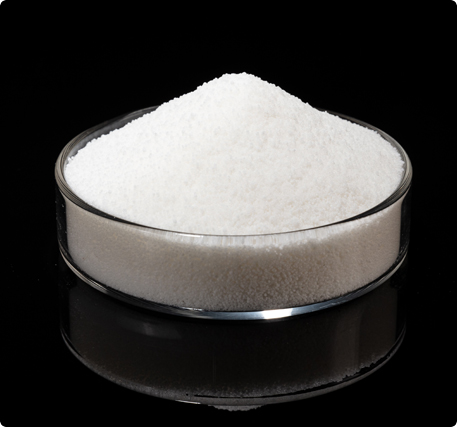
SSL emulsifier in fortified pasta


Calcium Stearoyl Lactylate (CSL, E482)


CSL is closely related to SSL but provides a milder and more balanced strengthening effect. It is often used when a more balanced texture is needed without making the pasta too firm.

Improves dough tolerance during extrusion
Enhances structure while keeping the texture less rigid than SSL
Suitable for fresh pasta and softer texture targets

Typical usage: 0.2–0.4%


DATEM (E472e)


In traditional pasta production, DATEM is not commonly used. However, it plays a key role in specialty pasta, especially when working with non-traditional raw materials.

Strengthens weak dough systems
Reduces breakage in high-fiber or legume-based pasta
Improves extrusion consistency and surface finish

It is particularly valuable when the traditional wheat gluten structure is compromised by alternative flours or added fibers.


Lecithin (E322)


Lecithin is often used in fresh or egg pasta, especially when a more natural or clean-label positioning is needed.

Improves dough handling and sheeting
Enhances surface smoothness
Works well alongside egg yolk


Dried vs. Fresh Pasta: Different Emulsifier Priorities


In dried pasta, the drying process is the critical stage. Pasta dried too quickly develops surface cracks; dried too slowly risks microbial issues. DMG at 0.3–0.5% helps maintain surface integrity through this process, and SSL can be added at 0.2–0.3% for texture improvement in the cooked product.

In fresh and refrigerated pasta, shelf life and cooking performance are the priorities. DMG is essential for anti-staling. SSL or lecithin improves dough handling during sheeting and cutting, and helps the pasta hold its texture through a 14–21 day refrigerated shelf life.

In egg pasta (tagliatelle, pappardelle, lasagne), egg yolk already provides some emulsification, but additional lecithin or DMG improves consistency at an industrial scale, where egg content varies between batches.

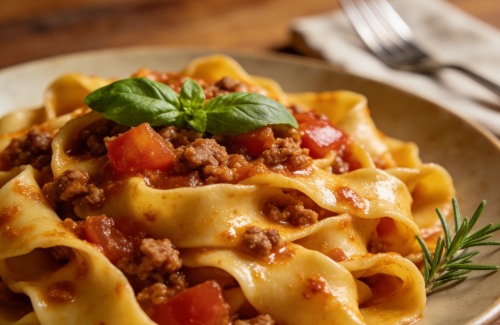
DMG emulsifier in pappardelle


Frequently Asked Questions


Do traditional Italian pasta recipes use emulsifiers?


Traditional artisan pasta doesn't. Emulsifiers are used in industrial production where consistency, throughput, and extended shelf life are required — not in small-batch or fresh pasta made and consumed the same day.
 

Which emulsifier is best for reducing pasta stickiness after cooking?


DMG (E471) is the most effective for this. It forms complexes with the surface starch during cooking that physically reduce adhesion between strands. At 0.3–0.5% of semolina weight, the difference in post-cook stickiness is noticeable.
 

Can emulsifiers improve gluten-free pasta quality?


Yes, and they become more important in gluten-free formats. Rice, corn, or chickpea-based pasta has no gluten network to hold it together during extrusion or cooking. DMG and SSL help compensate for this, reducing the tendency of gluten-free pasta to become mushy or fall apart.


Do emulsifiers affect the color and appearance of dried pasta?


Yes, emulsifiers can improve dough cohesion and surface smoothness, reducing white spots and micro-cracks during drying. This helps produce the uniform, pale yellow appearance typical of high-quality durum pasta. When used at recommended levels, emulsifiers do not darken or discolor the product.
 

Is there a risk of overdosing emulsifiers in pasta?


At very high levels, DMG can cause slight surface greasiness or affect the color of the cooked pasta. Staying within the recommended range of 0.3–0.5% of semolina weight avoids these issues in practice.
 

About Chemsino


Founded in 2006, Henan Chemsino Industry Co., Ltd (Chemsino) specializes in the development and supply of high-quality food emulsifiers for diverse applications.

We offer food-grade DMG (E471), SSL (E481), CSL (E482), and DATEM (E472e), widely used in pasta and other processed foods to improve texture, stability, and processing performance. All products are certified Halal, Kosher, ISO 9001, ISO 22000, and RSPO. Contact us to request samples or discuss your formulation.
Start earning substantial
profits in your country today!
Email
Whatsapp