Home
Products
Emulsifier List
Application
Gallery
News
Blog
About Us
About Us
Contact Us
Your Position : Home > Blog

What Is Polysorbate 60 Liquid and How Is It Used in Food and Cosmetics?

Date:2025-06-03
Read:
Share:
Polysorbate 60 liquid is a versatile, non-ionic surfactant widely used as an emulsifier, solubilizer, and stabilizer in both the food and cosmetic industries. Its liquid form makes it especially convenient for manufacturing processes that require ease of handling, rapid dispersion, and consistent emulsification.


What Is Polysorbate 60 Liquid?


Polysorbate 60, also known as Tween 60 (Polyoxyethylene sorbitan monostearate), is a polyoxyethylene derivative of sorbitan monostearate, classified as E435 in food applications. Polysorbate 60 liquid has a high HLB value (14.9), which means better water solubility (hydrophilicity) and process flexibility. It is yellow to amber in color, viscous, and completely soluble in water and alcohol, making it ideal for use in aqueous systems.

Key Properties:
INCI Name: Polysorbate 60
CAS Number: 9005-67-8
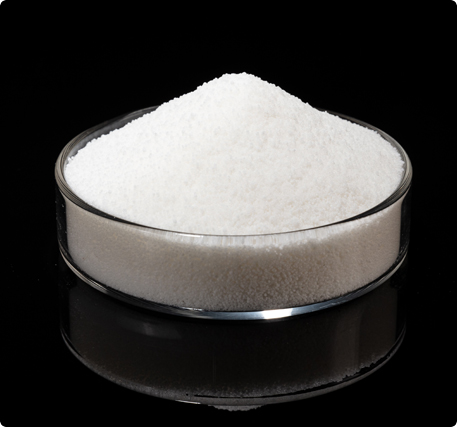
Appearance: Amber liquid
Solubility: Water-soluble                                                                                  
Function: Emulsifier, solubilizer, dispersing agent, stabilizer

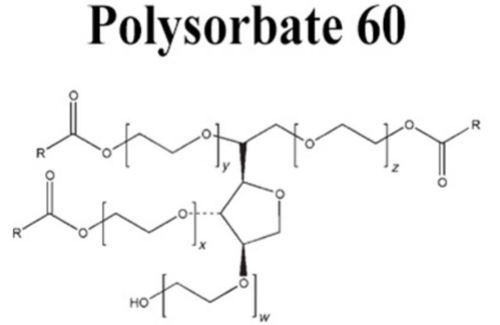
Chemical Structural Formula of Polysorbate 60


Polysorbate 60 in the Food Industry


In food formulations, Polysorbate 60 liquid plays a crucial role in forming and maintaining stable oil-in-water emulsions. It improves product texture, volume, shelf life, and mouthfeel.

Common Food Applications:
Whipped toppings – enhances overrun and foam stability
Non-dairy creamers – prevents phase separation
Baked goods – improves crumb structure and softness
Instant desserts and puddings – stabilizes fat and water phases

Polysorbate 60 is approved by regulatory bodies such as the FDA and EFSA for use in limited concentrations in processed foods.


Polysorbate 60 in the Cosmetics Industry


In cosmetic and personal care formulations, Polysorbate 60 liquid is valued for its emulsifying and solubilizing abilities. It helps blend oil- and water-based ingredients smoothly and improves product spreadability and texture.

Common Cosmetic Applications:
Creams and lotions – stabilizes oil and water emulsions
Facial cleansers – helps solubilize oils in water
Hair conditioners – enhances consistency and emulsification
Bath oils and makeup removers – aids in even dispersion in water

Its mildness and compatibility with a wide range of ingredients make it ideal for sensitive-skin formulations.

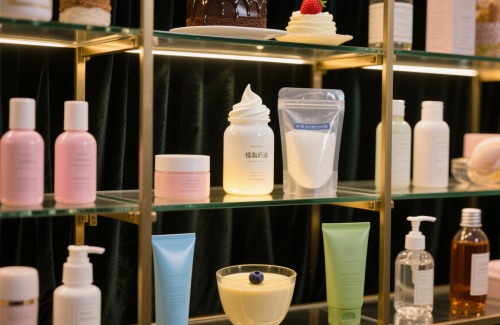
Polysorbate 60 in food and cosmetic


What are the benefits of polysorbate/Tween 60 liquid?


Compared to powder or semi-solid forms, Polysorbate 60 liquid offers:
Easier dosing and mixing in large-scale production
Faster dispersion in water and oil
Better control over viscosity and texture in final products
Reduced processing time and cost


Is polysorbate 60 safe to eat?


Yes, polysorbate 60 is generally recognized as safe to eat when used within approved limits. It is a food-grade emulsifier (E435) approved by regulatory authorities such as the FDA and EFSA, commonly used in products like whipped toppings, baked goods, and non-dairy creamers. At typical usage levels, it poses no known health risks to the general population.


Conclusion


Whether you're formulating baked goods or luxury skincare, Polysorbate 60 liquid is a reliable, high-performance emulsifier that enhances stability, texture, and overall product quality. If you're seeking a trusted supplier of high-quality Polysorbate 60 liquid, CHEMSINO offers stable quality, fast delivery, and customized products.Contact us today to request a sample.
 
Related Blog
PGE vs DMG
Polyglycerol Esters (PGE) vs Distilled Monoglycerides (DMG)
17 Apr 2026
Polyglycerol Esters (PGE) and Distilled Monoglycerides (DMG) are widely used food emulsifiers that play an important role in improving texture, stability, and overall product quality. Although both help create stable and uniform systems, they differ in structure and performance. Understanding how PGE and DMG work in different applications helps manufacturers choose the right ingredient for better formulation results and more consistent production.
Polysorbate 80 VS. Polysorbate 20: What's the Difference?
Polysorbate 80 VS. Polysorbate 20: What's the Difference
05 Jun 2024
In everyday products like food, pharmaceuticals, and cosmetics, additives are vital. Polysorbate 80 and Polysorbate 20, both surfactants, are commonly encountered. Despite their similar names, they have distinct applications. This article will elucidate the disparities between Polysorbate 80 and Polysorbate 20, aiding in better understanding their utility in different contexts.
What Emulsifier is Used in Ice Cream
15 Mar 2024
Emulsifiers are essential parts in ice cream production, playing a crucial role in creating the fantastic and popular product. This post provides a comprehensive overview of ice cream emulsifiers, including why emulsifiers are used in ice cream, common emulsifiers for ice cream(Lecithin, mono- and diglycerides, Polysorbate 80, and Polyglycerol Esters of Fatty Acids), natural vs. Synthetic emulsifiers in ice cream, as well as ice cream emulsifiers buying guidance.
Start earning substantial
profits in your country today!
Email
Whatsapp