Home
Products
Emulsifier List
Application
Gallery
News
Blog
About Us
About Us
Contact Us
Your Position : Home > Blog

Polyglycerol Esters of Fatty Acids (PGE) in Flavored Waters

Date:2026-03-30
Read:
Share:
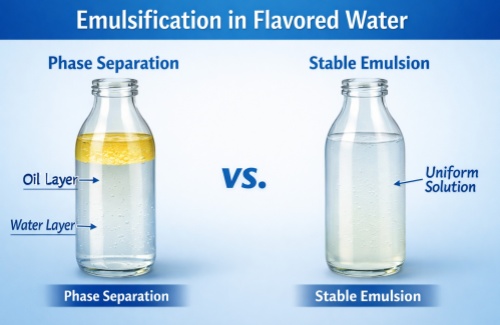
Flavored water looks simple, but keeping it clear, stable, and consistent throughout its shelf life is a real formulation challenge. Most flavors used in these products — citrus oils, botanical extracts, fruit essences — are oil-based and don't naturally mix with water. Without proper stabilization, the result is visible oil separation, cloudiness, ring formation on the bottle neck, and inconsistent flavor from sip to sip.

Polyglycerol Esters of Fatty Acids (PGE, E475) are one of the most effective emulsifiers for solving this problem in low-fat beverage systems. This blog explains how PGE works in flavored water, how to use it correctly, and how it compares to other emulsifier options.


Why Flavored Water Is Difficult to Stabilize


The challenge in flavored water is the combination of very low oil content and very low viscosity. Unlike a salad dressing or a dairy beverage, flavored water has almost no natural structure to hold oil droplets in suspension. The oil phase is typically 0.01–0.1% of the total formula — small enough that it seems manageable, but enough to cause visible separation if not properly emulsified.

Droplet size is the critical variable. Large droplets rise to the surface quickly (creaming) or scatter light (cloudiness). An effective emulsifier reduces droplet size during homogenization and keeps those droplets stable over the product's shelf life — often 6–12 months for ambient-stored flavored water.

Oil-Water Separation vs Stable Emulsion


How PGE Works in Flavored Water


PGE emulsifier is produced by esterifying polyglycerol with fatty acids, resulting in a molecule with both water-loving (hydrophilic) and oil-loving (lipophilic) properties. This dual nature allows it to sit at the oil-water interface, forming a stable film around each oil droplet that prevents coalescence and separation.

In flavored water specifically, PGE offers three practical advantages:

Fine droplet stabilization at low concentrations. PGE is effective at 0.05–0.2% based on total formula weight — low enough to avoid any impact on taste or mouthfeel while still providing meaningful emulsification. At these levels, it helps achieve droplet sizes below 1 micron when combined with high-shear processing, which is the threshold for maintaining a visually clear product.

Stability in acidic conditions. Most flavored waters are mildly acidic (pH 3–5) due to added citric acid or natural fruit flavors. PGE performs reliably within this pH range, which is an important practical advantage over some other emulsifiers that lose effectiveness at low pH.

Compatibility with a wide range of flavor oils. PGE works with citrus oils, mint, berry extracts, and most botanical flavor systems commonly used in functional and flavored water products.

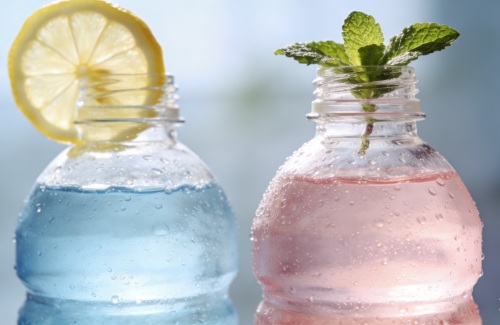
flavored water beverages


How to Use PGE Effectively in Production


Getting consistent results with PGE depends as much on process as it does on dosage.

Pre-mix with the flavor oil first. Before adding PGE to the water phase, blend it thoroughly with the flavor oil. This ensures the emulsifier coats the oil phase before the two phases are combined, which leads to finer, more uniform droplet formation during mixing.

Use high-shear processing. PGE requires adequate mechanical energy to reduce droplet size to stable levels. A high-pressure homogenizer operating at around 150–300 bar is a commonly used approach for producing stable emulsions in food processing, although the exact pressure depends on the specific formulation and application.

Validate under real storage conditions. Emulsion stability in the lab doesn't always predict shelf-life behavior. Test the finished product at the intended storage temperature — and at elevated temperature (e.g., 40°C for 4 weeks as an accelerated stress test) — before finalizing the formula.


PGE vs. Other Emulsifiers in Flavored Water


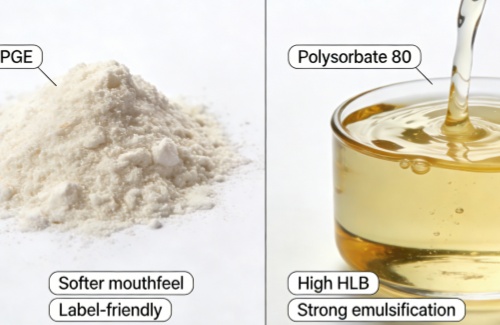
PGE vs. Polysorbate 80 (E433): Both are effective in low-fat beverage systems. Polysorbate 80 has a higher HLB value and is particularly efficient in very low-oil systems. PGE tends to offer a slightly softer mouthfeel and is often preferred when label positioning matters, as it's perceived as closer to natural. In practice, both are used, and the choice often comes down to specific flavor oil compatibility and cost.

PGE VS Polysorbate 80

PGE vs. Lecithin: Lecithin is a natural-origin emulsifier and popular in clean-label formulations, but it can introduce slight color and flavor contributions — undesirable in clear, neutral-flavored water. PGE is flavor-neutral and color-neutral at normal usage levels, making it better suited for products where clarity and taste purity are priorities.

Combination systems: In demanding formulations — long shelf life, temperature-variable storage, or very low oil levels — PGE is often combined with a weighting agent (such as sucrose acetate isobutyrate or modified starch) and a stabilizer (such as xanthan gum at 0.05–0.1%) for additional suspension support. No single ingredient does everything in a challenging beverage system.


Frequently Asked Questions


Is PGE approved for use in beverages?


Yes. PGE (E475) is approved under EU food additive regulations and holds FDA GRAS status in the United States. It is also accepted in most other major markets.
 

Does PGE affect the taste of flavored water?


At normal usage levels (0.05–0.2%), PGE has no detectable effect on taste or mouthfeel. Its function is purely structural.
 

Can PGE keep flavored water clear?


Yes, provided the processing conditions — particularly homogenization pressure — are sufficient to achieve small droplet sizes. PGE alone cannot compensate for inadequate processing.
 

What's the shelf life of a PGE-stabilized flavored water?


This depends on the full formulation and storage conditions. With proper emulsification and appropriate pH (3–5), PGE-stabilized flavored waters typically achieve 6–12 months of ambient shelf life without visible separation.
Related Blog
What Are Polyglycerol Esters Of Fatty Acids
03 Apr 2024
Polyglycerol esters of fatty acids are formed by the direct esterification of polyglycerol with fatty acids. They are a group of superior non-ionic surfactants and emulsifiers. With excellent emulsifying, dispersing, wetting, and stabilizing capabilities, they are extensively utilized in the food industry. This blog focuses on the E475 emulsifier, detailing its functions and applications on food products.
Emulsifiers in Baked Goods
14 Oct 2024
Baked goods hold a significant place in daily diets worldwide, from bread to cakes and cookies, making them beloved by consumers. This article explores the multiple functions of emulsifiers in yeast-leavened (e.g., bread) and chemical-leavened (e.g., cakes, cookies) products, clarifies key roles, addresses misconceptions, and provides usage guidelines while examining future industry trends.
A Complete Guide to Cake Emulsifiers
12 Apr 2024
Emulsifiers play a crucial role in cakes by enhancing their overall quality and consistency. They effectively blend ingredients together, ensuring a smooth batter with uniform distribution, which ultimately improves the cake's appearance and texture while reducing mixing time. These additives typically contain components that attract both oil and water, allowing them to bind these two typically incompatible substances. This binding action creates a stable mixture, resulting in a consistent final product that is easier to work with during the baking process.
Start earning substantial
profits in your country today!
Email
Whatsapp