Home
Products
Emulsifier List
Application
Gallery
News
Blog
About Us
About Us
Contact Us
Your Position : Home > Blog

Food Emulsifier Specifications Explained

Date:2026-06-22
Read:
Share:
When a Certificate of Analysis (CoA) lands on your desk, it's easy to treat it as a box-checking exercise. Acid value? In range. Saponification value? Passes. Approved.

But each parameter on that CoA is telling you something specific about the emulsifier — its identity, its quality, its stability risk, and whether it will actually perform in your formulation. Knowing how to read these numbers turns a CoA from a formality into a genuine quality tool.

This guide covers every major specification you'll encounter on a food emulsifier CoA, what it measures, typical ranges, and what to do when something looks off.

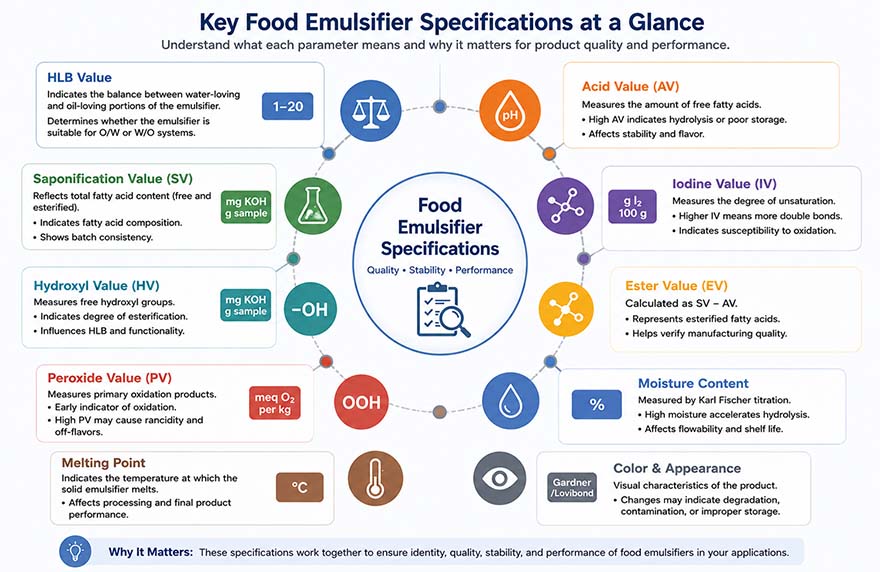
1. HLB Value (Hydrophilic-Lipophilic Balance)


What it is: A scale from 0 to 20 describing how oil-soluble or water-soluble an emulsifier is. Low HLB = more oil-soluble. High HLB = more water-soluble.

Why it matters: Matching HLB to your application determines whether you get a stable emulsion or an unstable one. The wrong HLB doesn't just reduce performance — it can invert an emulsion or cause phase separation entirely.
 
HLB Range Function Typical Use
3–6 W/O emulsifier Margarine, cold cream, spreads
7–9 Wetting agent Coatings, dispersants
8–16 O/W emulsifier Dressings, beverages, dairy products
15–18 Solubilizer Flavor and vitamin solubilization

What to watch:
 HLB is usually calculated or empirically determined, not measured directly. If the supplier's stated HLB doesn't align with your formulation's required HLB, run a bench-scale emulsification trial before accepting the lot.

2. Acid Value (AV)


What it is: The milligrams of KOH required to neutralize the free fatty acids in one gram of emulsifier. It measures how much hydrolytic breakdown has already occurred.

Why it matters: Free fatty acids are produced when ester bonds break down under moisture or heat. A high acid value means degradation has happened — either during manufacturing, storage, or transport.

Typical range: Below 5–10 mg KOH/g for most synthetic emulsifiers. Lecithin has a naturally higher AV.

What to watch: An elevated AV on incoming material raises questions about storage conditions and functional integrity. Don't accept a borderline lot on CoA alone — run a functional check before releasing it to production.


3. Saponification Value (SV)


What it is: The total milligrams of KOH required to saponify one gram of emulsifier, covering both free and esterified fatty acids. It reflects the average molecular weight and fatty acid chain composition of the material.

Why it matters: SV is essentially a fingerprint of the fat feedstock. A deviation from specification suggests a change in raw material source or fatty acid profile — which can shift HLB, melting behavior, and functional performance even if the material looks fine on other parameters.

What to watch: Track SV across consecutive lots from the same supplier. Drift within specification is still worth flagging — consistent drift often precedes an out-of-spec result.

4. Iodine Value (IV)


What it is: Grams of iodine absorbed per 100 grams of sample. It quantifies how many carbon-carbon double bonds are present in the fatty acid chains — in other words, the degree of unsaturation.

Why it matters: Unsaturated fatty acids oxidize faster than saturated ones. A higher iodine value means higher oxidative risk, which shortens usable shelf life and increases the chance of rancidity-related off-flavors in your finished product.

Typical range: Fully hydrogenated emulsifiers like distilled GMS typically show IV below 3. Higher values indicate partial hydrogenation or unsaturated feedstock.

What to watch: An unexpectedly high IV in a nominally saturated emulsifier is a direct signal of raw material substitution or incomplete hydrogenation. Treat it as a red flag, not a minor deviation.

5. Hydroxyl Value (HV)


What it is: Milligrams of KOH equivalent to the free hydroxyl groups in one gram of emulsifier. It measures how many –OH groups remain unreacted after esterification.

Why it matters: For polyol-based emulsifiers — glycerol esters, sorbitan esters, polyglycerol esters — the degree of esterification directly controls HLB and functional behavior. A high hydroxyl value means esterification didn't go far enough. The result is a product with a different HLB than specified and different emulsification performance.

What to watch: Compare HV against the saponification value. The relationship between the two lets you calculate ester value and confirm that the reaction reached the intended endpoint.

6. Ester Value (EV)


What it is: Calculated as saponification value minus acid value. It represents the portion of fatty acids that are esterified rather than free.

Why it matters: Ester value is an internal consistency check. It lets you verify that AV, SV, and HV are all telling the same story. If one value is anomalous while the others look normal, the ester value helps identify which is out of place.

7. Peroxide Value (PV)


What it is: Milliequivalents of active oxygen per kilogram of sample. It measures primary oxidation products — hydroperoxides — which form in the early stages of lipid oxidation.

Why it matters: PV is the earliest warning sign of oxidative degradation — it rises before any off-flavor or odor becomes detectable. By the time a product smells rancid, PV has already been elevated for some time.
Typical range: Most food-grade emulsifier specifications set PV below 5–10 meq/kg.

What to watch: Unlike acid value, peroxide value cannot be reversed. Oxidized material stays oxidized. Lots with elevated PV should be rejected, not conditionally accepted. Elevated PV in incoming material points to poor storage conditions — inadequate temperature control, oxygen exposure, or light exposure during transit or warehousing.

8. Water Content (Moisture)


What it is: Percentage of water present, measured by Karl Fischer titration — the standard method for accurate low-level moisture detection.

Why it matters: Moisture is the primary driver of hydrolytic degradation. Even small amounts accelerate the breakdown of ester bonds, pushing acid value up over time. In powdered emulsifiers, excess moisture causes caking and uneven flow. In chocolate applications, trace moisture triggers sugar crystallization and disrupts tempering.

Typical range: Below 1–2% for most food emulsifiers. Specialty grades may require below 0.5%.

What to watch: Moisture content at receipt doesn't guarantee moisture stability over the product's shelf life. Check storage conditions — temperature, humidity, and packaging integrity — and re-test if there's any doubt.


9. Melting Point and Solidification Point


What it is: The temperature range at which a solid emulsifier transitions to liquid, measured by standard thermal methods.

Why it matters: Melting behavior determines when and how an emulsifier activates in a food system. An emulsifier with a lower-than-specified melting point may activate too early in a bakery dough, disrupting gluten development. In chocolate, it can interfere with cocoa butter crystallization and tempering, producing bloom or poor snap.

What to watch: A shifted melting point usually indicates a change in fatty acid chain length distribution or incomplete hydrogenation — both of which affect functional performance, not just thermal behavior.


10. Color and Appearance


What it is: Color is measured on the Gardner or Lovibond scale. Appearance covers physical form — powder, flake, bead, granule, or liquid.

Why it matters: These seem like cosmetic parameters, but they're not. Color darkening beyond specification typically indicates thermal stress or contamination during production. A form change — powder that has partially melted and resolidified, for example — signals improper storage or temperature excursion during transport.

What to watch: Don't overlook appearance on a CoA because it seems minor. A visual anomaly is often the first sign of a handling or storage problem that hasn't yet shown up in chemical values.

How to Read a CoA as a System


Individual parameters tell you pieces of the story. The full picture only appears when you look at them together.
A practical CoA review follows four steps:

Step 1 — Identity: Does SV align with the expected fatty acid profile? Does HLB match your formulation's requirement?

Step 2 — Quality: Are AV, PV, and moisture within limits? Do the values indicate fresh, properly handled material?

Step 3 — Consistency: How does this lot compare to the previous three or four? Drift within specification is still a signal worth tracking.

Step 4 — Functional verification: For critical applications, a CoA confirms composition but not performance. Run a bench-scale test alongside the paperwork review.

Regulatory Specification Limits vs. Internal Limits


Not every spec limit carries the same weight. Regulatory limits — such as maximum use levels under FDA 21 CFR or EU Regulation (EC) No 1333/2008 — are hard limits. They are not subject to negotiation or deviation approval.
Internal specification limits set by your company or your supplier are negotiable, but only with data to support the deviation. If a supplier requests a conditional acceptance on a borderline lot, the right response is: show me the functional data. Without it, you're absorbing risk without any basis for doing so.

Working with CHEMSINO on Emulsifier Specifications


CHEMSINO has focused on food-grade emulsifiers for over a decade — GMS, SSL, sorbitan esters, lecithin-based products, and custom blends. In that time, we've developed CoA frameworks and internal specification limits based on real production experience across bakery, dairy, confectionery, and beverage applications.

Every batch we ship includes a full CoA with actual test results — not specification ranges with no data. Our QC team tests each lot prior to release. And when customers have questions about how to interpret a specification, select between grades, or diagnose a formulation problem, our technical team works through it directly.

We don't cover every ingredient category. We cover emulsifiers — specifically and in depth. That's the kind of supplier relationship that makes a difference when a specification question becomes a production-line problem.


Quick Reference: Food Emulsifier Specification Parameters

 
Parameter What It Measures Key Risk If Off-Spec
HLB Oil/water affinity Wrong emulsion type, instability
Acid Value Free fatty acids / hydrolysis Degradation, off-flavor
Saponification Value Fatty acid profile and MW Raw material substitution
Iodine Value Unsaturation / oxidative risk Rancidity, shortened shelf life
Hydroxyl Value Degree of esterification Shifted HLB, poor performance
Ester Value Esterified fatty acid content Internal consistency check
Peroxide Value Primary oxidation stage Rancidity, off-flavor (irreversible)
Water Content Moisture level Hydrolysis, caking, chocolate defects
Melting Point Fatty acid profile / hydrogenation Wrong activation timing
Color / Appearance Thermal and handling history Degradation, storage issues

FAQ


Q: What is the most important specification of a food emulsifier?

There is no single most important parameter. HLB value, active content, acid value, peroxide value, and moisture content should all be evaluated together.

Q: What does a high acid value indicate?

It usually indicates hydrolysis, moisture contamination, poor storage conditions, or product degradation.

Q: Why is peroxide value important?

Peroxide value provides an early warning of oxidation before off-flavors become noticeable.

Q: Can an emulsifier pass CoA but still fail in production?

Yes. A CoA verifies composition but cannot guarantee performance under specific processing conditions.

Q: How often should emulsifier specifications be monitored?

Every incoming batch should be reviewed, and trends should be monitored over time to detect quality drift.
Start earning substantial
profits in your country today!
Email
Whatsapp