Home
Products
Emulsifier List
Application
Gallery
News
Blog
About Us
About Us
Contact Us
Your Position : Home > Blog

Best Emulsifiers for Water-in-Oil Emulsions

Date:2026-03-20
Read:
Share:
Water-in-oil (W/O) emulsions play a crucial role in many food products, from margarine and butter spreads to chocolate and fat-based fillings. In these systems, tiny droplets of water are dispersed within a continuous oil or fat phase. However, because water and oil naturally repel each other, creating a stable emulsion requires the right emulsifier.

From my experience working with food ingredient applications, choosing the correct emulsifier is one of the most important factors in determining product stability, texture, and processing efficiency. The right emulsifier can prevent phase separation, improve mouthfeel, and even reduce manufacturing costs. This article will explain how water-in-oil emulsions work and the best emulsifiers used in the food industry to stabilize them.


What Is a Water-in-Oil Emulsion?


A water-in-oil emulsion is a system in which water droplets are dispersed inside a continuous oil phase. This structure is the opposite of oil-in-water emulsions such as milk or mayonnaise.

In a W/O emulsion:

 
· Oil or fat forms the continuous phase
· Water forms the dispersed phase
· Emulsifiers stabilize the interface between oil and water

These emulsions are widely used in food products such as:

 
· Margarine and butter spreads
· Chocolate and confectionery fillings
· Fat-based sauces
· Bakery creams and shortenings

According to industry research, the global margarine and spreads market exceeded $28 billion in 2023, and stable W/O emulsions are essential for producing these products. This demonstrates how critical emulsifier technology is in modern food processing.

bakery cream


Key Characteristics of W/O Emulsifiers


Emulsifiers suitable for water-in-oil systems usually have the following characteristics:

Low HLB value
They are more lipophilic (oil-loving) than hydrophilic.
Good fat compatibility
They dissolve easily in oils or fats.
Strong interfacial stabilization
They reduce surface tension between water droplets and the oil phase.


Best Emulsifiers for Water-in-Oil Emulsions


1. Sorbitan Monostearate


Sorbitan monostearate is one of the most effective emulsifiers for water-in-oil emulsions. It has a low HLB value (around 4.7), making it ideal for stabilizing water droplets in fat systems.

Advantages

Excellent W/O stabilization

Good thermal stability

Widely used in margarine and fat spreads

Typical applications

Margarine

Shortening

Fat-based confectionery fillings


2. Polyglycerol Polyricinoleate


PGPR is a powerful emulsifier widely used in chocolate and confectionery products. It significantly reduces viscosity and improves the flow properties of chocolate.

Advantages

Extremely strong W/O emulsifying capability

Reduces viscosity in chocolate

Improves processing efficiency

Typical applications

Chocolate

Compound coatings

Confectionery fillings


3. Mono- and Diglycerides


Mono- and diglycerides are among the most widely used emulsifiers in the food industry. They can function in both O/W and W/O emulsions depending on formulation and processing conditions.

Advantages

Versatile emulsifier

Improves fat crystallization

Enhances texture and stability

Typical applications

Margarine

Shortening

Bakery creams

Margarine


Factors to Consider When Choosing a W/O Emulsifier


Selecting the right emulsifier depends on several formulation factors.


1. HLB Value


For W/O emulsions, emulsifiers with HLB values between 3 and 6 generally work best.


2. Fat Type


Different fats (palm oil, cocoa butter, vegetable oils) interact differently with emulsifiers.


3. Processing Conditions


Temperature, shear rate, and mixing method can significantly affect emulsion stability.


4. Desired Texture


Some emulsifiers improve creaminess, while others reduce viscosity or enhance spreadability.


Applications of Water-in-Oil Emulsions in Food


Water-in-oil emulsions are commonly found in several food products.


Margarine and spreads


Emulsifiers help disperse water droplets in the fat matrix and maintain a stable texture.
 

Chocolate products


Emulsifiers reduce viscosity and improve the flow properties of chocolate during processing.
 

Fat-based sauces and creams


They help maintain consistent texture and prevent separation.

Fat-based sauces


Bakery shortenings


Emulsifiers stabilize the fat structure and improve dough performance.
 

Final Thoughts


Water-in-oil emulsions play an important role in many food formulations, particularly in margarine, chocolate, and fat-based products. Choosing the right emulsifier is essential for achieving stability, improving texture, and ensuring consistent product quality.

Common W/O emulsifiers such as Sorbitan Monostearate, Polyglycerol Polyricinoleate, and Mono- and Diglycerides are widely used in the food industry due to their excellent lipophilic properties and emulsifying performance.

By selecting the appropriate emulsifier and optimizing formulation conditions, food manufacturers can develop stable, high-quality water-in-oil emulsion products.


FAQ


1. What is the best emulsifier for water-in-oil emulsions?


· Polyglycerol Polyricinoleate
· Sorbitan Monostearate
· Mono- and Diglycerides

These emulsifiers have low HLB values and strong oil compatibility.


2. What HLB value is suitable for water-in-oil emulsions?


Most W/O emulsifiers have an HLB value between 3 and 6. These emulsifiers dissolve better in oils and help stabilize water droplets in the oil phase.


3. Why is PGPR used in chocolate?


Polyglycerol Polyricinoleate reduces chocolate viscosity and improves flow during processing. This allows manufacturers to reduce cocoa butter usage while maintaining a smooth texture.


4. Why are emulsifiers important in margarine production?


Emulsifiers ensure that water droplets remain evenly distributed within the fat phase. This prevents phase separation and ensures a smooth, spreadable texture.
Related Blog
Food Grade vs. Pharmaceutical Grade Propylene Glycol
11 Nov 2024
Propylene glycol (PG) is a versatile and widely used compound, serving as a solvent, humectant, and preservative across various industries. From food production to pharmaceuticals, propylene glycol plays a crucial role in many everyday products.In this article, we will explore the key distinctions between food-grade and pharmaceutical-grade propylene glycol in terms of purity, quality, safety, and cost.
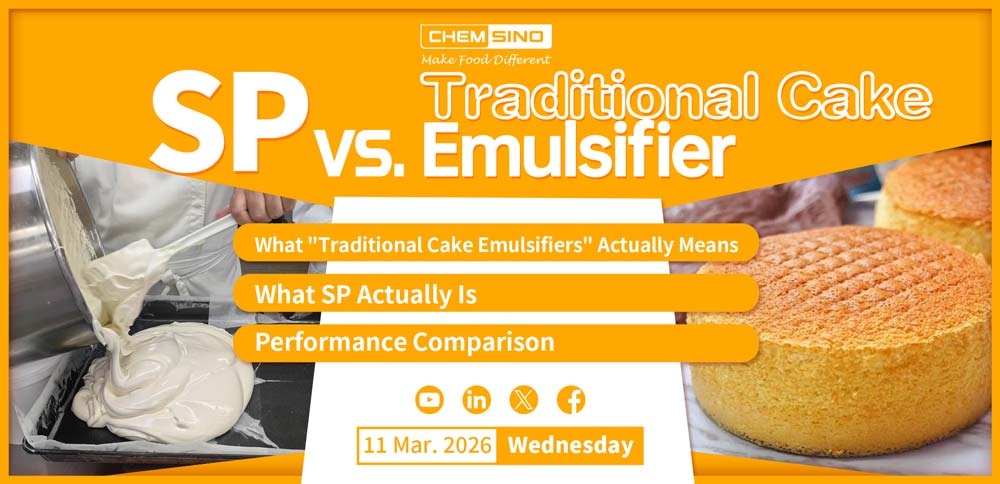
SP vs Traditional Cake Emulsifiers
SP vs. Traditional Cake Emulsifiers: What's the Difference?
11 Mar 2026
Cake emulsifiers play an important role in improving batter stability, aeration, and final cake texture. Traditional cake emulsifiers such as GMS, PGMS, lecithin, PGPR, and SSL are often used individually or in custom blends to achieve specific functions. SP, however, is a compound emulsifier designed to combine several functional effects in one ingredient. Understanding the differences between SP and traditional cake emulsifiers helps bakers and food manufacturers select suitable solutions for different cake formulations and production needs.
What are the Emulsifiers in Dairy Products
06 Jan 2025
In dairy production, many manufacturers constantly seek ways to improve product stability, texture, and shelf life. One of the most critical components in achieving these goals is the use of emulsifiers. These ingredients play an essential role in stabilizing the mixture of fat and water in dairy products, preventing separation and ensuring a smooth, uniform texture. This article will explore common dairy emulsifiers and how they help create quality products that meet consumer needs. Understanding emulsifiers gives us a better grasp of dairy production.
Start earning substantial
profits in your country today!
Email
Whatsapp