Span 60 (Sorbitan Monostearate), or its European food additive code, E491. It is one of the most widely used non-ionic surfactants in the world, appearing in everything from commercial bread and ice cream to skin creams, vaccine formulations, textile finishes, and industrial coatings.
Yet despite its ubiquity, Span 60 is often only partially understood. Formulators know it as "an emulsifier," but the full picture — what it is chemically, precisely how it stabilizes emulsions, why its HLB value matters, how it compares to related emulsifiers, and what makes it the right or wrong choice for a given application — is worth exploring in depth.
1. What Is Span 60?
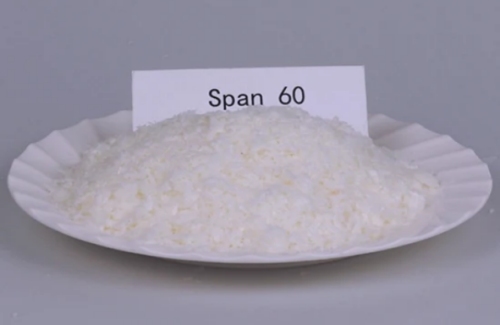
Span 60 is the trade name for Sorbitan Monostearate (SMS), a non-ionic surfactant produced by the esterification of sorbitol (a sugar alcohol naturally found in fruits and derived commercially from corn or potato starch) with stearic acid (a long-chain saturated fatty acid derived from vegetable or animal fats, most commonly palm or soybean oil).
The esterification reaction causes sorbitol to dehydrate and cyclize into a compound called sorbitan, and then one molecule of stearic acid forms an ester bond with one of the hydroxyl groups on that sorbitan ring. The result is a molecule with a clear dual character: a lipophilic (fat-loving) tail from the stearic acid chain, and a hydrophilic (water-attracting) head from the residual hydroxyl groups on the sorbitan ring.
Key identifying information:
| Property |
Detail |
| Chemical Name |
Sorbitan Monostearate |
| Common Trade Name |
Span 60 |
| Abbreviation |
SMS |
| E Number |
E491 |
| CAS Number |
1338-41-6 |
| Molecular Formula |
C₂₄H₄₆O₆ |
| Molecular Weight |
430.62 g/mol |
| HLB Value |
4.7 |
| Appearance |
White to pale yellow waxy powder or flake |
| Melting Point |
50–52°C |
| Odor |
Slight, characteristic |
| Solubility |
Insoluble in cold water; dispersible in hot water; soluble in ethanol, diethyl ether, methanol, warm oils |
2. The Chemical Properties of Span 60
Understanding how Span 60 works begins with appreciating its molecular architecture. The molecule is built from two components joined by an ester bond:
The sorbitan ring (hydrophilic head): When sorbitol loses a water molecule during processing, it forms a five-membered cyclic ether ring known as sorbitan. This ring retains multiple free hydroxyl (-OH) groups that are polar and water-attracting. These hydroxyl groups are responsible for the hydrophilic character of the molecule.
The stearic acid chain (lipophilic tail): Stearic acid is an 18-carbon saturated fatty acid (C18:0). Its long, straight hydrocarbon chain is nonpolar and strongly lipophilic — it is attracted to oils and fats and repelled by water. When this chain is esterified onto the sorbitan ring, it becomes the molecule's "fat-loving" arm.
This dual structure — hydrophilic head, lipophilic tail — is the defining characteristic of all surfactants, and it is what allows Span 60 to position itself at the interface between oil and water, reducing interfacial tension and enabling the formation and stabilization of emulsions.
The HLB Value: The Key to Understanding Span 60's Character
The Hydrophilic-Lipophilic Balance (HLB) is a numerical scale from 0 to 20 used to characterize emulsifiers according to their relative affinity for water versus oil. An HLB value below 6 indicates a predominantly lipophilic (oil-loving) emulsifier; above 8, a predominantly hydrophilic (water-loving) one.
Span 60's HLB value of 4.7 places it firmly in the lipophilic range. This has a direct practical implication: Span 60 is naturally suited to forming and stabilizing water-in-oil (W/O) emulsions — systems where small water droplets are dispersed throughout a continuous oil phase. This is the emulsion type found in products like margarine, butter, certain creams, and fat-based confectionery coatings.
When a formulator needs the opposite — an oil-in-water (O/W) emulsion like a lotion, sauce, or dairy cream — Span 60 is typically combined with a high-HLB emulsifier (most commonly its ethoxylated counterpart, Polysorbate 60 / Tween 60, which has an HLB of ~14.9) to achieve a blended HLB value in the 8–12 range required for O/W stability. This Span/Tween co-emulsifier system is one of the most widely used and reliable approaches in industrial emulsification.
3. How Does Span 60 Work as an Emulsifier?
At its core, Span 60 works by reducing interfacial tension between oil and water — the surface energy that normally drives these two immiscible liquids apart. Here is a step-by-step account of the mechanism:
Step 1 — Migration to the interface. When Span 60 is introduced into a system containing both oil and water, its amphiphilic structure drives it to migrate to the oil-water interface. The lipophilic stearic acid tail embeds into the oil phase; the hydrophilic sorbitan head orients toward the water phase.
Step 2 — Reduction of surface tension. By occupying the interface, Span 60 molecules reduce the interfacial tension between oil and water, making it energetically easier for small droplets to form and less likely for them to spontaneously coalesce back into a separated state.
Step 3 — Formation of an interfacial film. As emulsification proceeds (through mixing, homogenization, or shear), Span 60 molecules pack together at the surface of the dispersed droplets, forming a protective interfacial film. This film creates a physical and electrostatic barrier that prevents droplets from merging.
Step 4 — Stabilization of the emulsion. The interfacial film maintained by Span 60 gives the emulsion kinetic stability — the droplets remain dispersed over time, even though thermodynamically they would prefer to separate. For W/O emulsions, this stability is particularly robust because Span 60's lipophilic character reinforces the oil as the continuous phase.
Beyond pure emulsification, Span 60 performs several additional functional roles depending on the application context, as detailed in the next sections.
4. Span 60 in Food Applications
Span 60 (E491) is approved for use in food by the U.S. FDA, EFSA (as E491), Codex Alimentarius, and under China's GB 2760 food additive standard. Its functional versatility makes it valuable across multiple food categories.
Bakery and Bread
In bread and baked goods, Span 60 is a powerful dough conditioner and anti-staling agent. It works through several mechanisms simultaneously:
* It interacts with starch molecules to slow retrogradation — the crystallization process that makes bread go stale — by forming inclusion complexes with amylose chains in a similar manner to other fatty acid-based emulsifiers.
* It improves fat dispersion in dough, ensuring shortening or oil is more uniformly distributed, which contributes to a finer and more uniform crumb structure.
* It enhances dough strength and handling properties, making the dough more extensible and better able to retain gas during fermentation.
* When mixed with shortening at a usage rate of 0.35–0.50% of flour weight, it makes bread noticeably softer and delays staling, extending effective shelf life meaningfully.
Span 60 also works synergistically with other emulsifiers in bread improver blends — particularly with mono- and diglycerides (DMG) and lecithin — for enriched, high-fat doughs where both aeration and starch interaction benefits are needed simultaneously.
Instant Dry Yeast Protection
One of Span 60's most specific and important food applications is in instant dry yeast (IDY). During the drying process used to produce IDY, yeast cells are subjected to osmotic stress that can damage their cell membranes. Sorbitan monostearate is added to the yeast during production specifically to protect the integrity of the yeast cell membrane during dehydration, preserving viability and ensuring that the yeast rehydrates rapidly and fully when added to dough.
This application is so important that E491 is considered the defining functional additive in commercial instant dry yeast, with usage levels carefully controlled to optimize protection without interfering with fermentation activity.
Ice Cream and Frozen Desserts
In ice cream and frozen dessert formulations, Span 60 delivers multiple functional benefits:
* Fat dispersion: It promotes even distribution of fat globules throughout the mix, preventing fat agglomeration or separation.
* Emulsion stability: It stabilizes the oil-in-water emulsion of the ice cream mix during processing, pasteurization, and aging.
* Fat aggregation during freezing: During the freezing and aeration phase, controlled fat aggregation (partial coalescence) is actually desirable — it contributes to the body, texture, and overrun of the ice cream. Span 60 facilitates this at the appropriate rate.
* Ice crystal control: By stabilizing the emulsion and influencing fat-protein interactions during freezing, Span 60 helps limit the growth of large ice crystals, contributing to a smoother, creamier texture.
* Shape stability: The finished product is firmer, more stable in shape, and more resistant to heat shock (temperature cycling during distribution and retail).
Typical usage level in ice cream is 0.20–0.30% of total mix weight.
Chocolate and Confectionery
In chocolate, Span 60 addresses one of the industry's most persistent quality challenges: fat bloom. Fat bloom is the white, hazy film that develops on the surface of chocolate when cocoa butter fat crystals migrate to the surface and recrystallize into unstable polymorphs. Span 60 prevents bloom by:
* Helping maintain a more stable, uniform fat crystal structure (primarily the desired Form V polymorph of cocoa butter)
* Slowing the migration of mobile fat fractions to the surface
* Improving the overall gloss and visual appeal of chocolate surfaces
In addition to bloom prevention, Span 60 also improves flow properties in chocolate coatings, reduces the tendency of fat to go rancid (by reducing the exposure of fat to oxygen through better emulsification), and enhances the brittleness and snap of finished chocolate. In high-fat confectionery such as caramel, cream candy, and nut pastes, it prevents oil-water separation and maintains textural stability throughout shelf life.
Margarine and Fat Spreads
Span 60 functions in margarine as a crystal modifier and emulsion stabilizer. It helps control the polymorphic form of the fat crystals, promoting a fine, uniform crystal structure that gives margarine its smooth, plastic texture and good spreadability. It also stabilizes the water droplets dispersed within the fat phase, preventing their coalescence and "weeping" (water separation) during storage.

5. Span 60 in Pharmaceutical Applications
The pharmaceutical industry relies on Span 60 primarily as a lipophilic excipient — a functional ingredient in the formulation of drug delivery systems rather than an active pharmaceutical ingredient itself.
Creams and ointments: Span 60 is widely used as the lipophilic component in creams and ointments, either alone to produce W/O emulsions, or in combination with hydrophilic co-emulsifiers (Polysorbates, cetyl alcohol) to produce O/W emulsions. Its HLB of 4.7 makes it particularly suitable for rich, occlusive (moisture-sealing) formulations such as barrier creams, medicated ointments, and dermatological preparations.
Suppositories: Span 60's waxy, solid character at room temperature (melting point 50–52°C) makes it suitable as a matrix component in suppository formulations, where it contributes to controlled release and structural integrity.
Drug solubilization and bioavailability: In lipid-based drug delivery systems (LBDDS), Span 60 acts as an emulsifying component that helps solubilize poorly water-soluble active pharmaceutical ingredients (APIs), improving their dissolution and bioavailability. Its compatibility with a wide range of oils, waxes, and excipients makes it versatile across multiple dosage forms.
Vaccine and biological formulations: Span 60 and related sorbitan esters are used in the preparation of adjuvant emulsions for vaccines, where stable W/O or O/W emulsions are required to deliver antigen and immunostimulatory components together.
Pharmaceutical-grade Span 60 is manufactured to United States Pharmacopeia (USP/NF) and European Pharmacopoeia (EP) standards, ensuring purity, batch-to-batch consistency, and documentation suitable for regulated drug applications.
6. Span 60 in Cosmetics and Personal Care
The cosmetic and personal care industry is one of the largest application sectors for Span 60, with the ingredient appearing in an enormous range of product types:
Skin creams and lotions: Span 60 is a staple emulsifier in both W/O and O/W skin emulsions. Its lipophilic character contributes to the occlusive, emollient feel of night creams and protective barrier formulations. It helps maintain emulsion stability across the temperature and mechanical stress of typical consumer use.
Sunscreens: In sunscreen formulations, Span 60 helps stabilize the emulsion and ensures that UV-filter actives (both mineral and chemical) remain evenly distributed throughout the product rather than migrating or separating.
Shampoos and hair care: Span 60 contributes to the conditioning and detangling performance of leave-in conditioners and certain rinse-out treatments, functioning as a co-emulsifier and texture modifier.
Antiperspirants and deodorants: In stick formulations, Span 60's waxy character and emulsifying properties contribute to the structural integrity of the product and the even distribution of active antiperspirant compounds.
A key advantage of Span 60 in cosmetic applications is that it is approved as a natural ingredient by Ecocert, making it suitable for formulations targeting natural or organic certification — an important credential in the premium personal care market.
7. Industrial Applications
Beyond food, pharma, and cosmetics, Span 60 finds significant use across a range of industrial sectors:
Plastics and polymers: Span 60 serves as an antistatic agent and lubricant in plastic processing, reducing static charge buildup on polymer surfaces and improving the flow and processability of thermoplastic resins. It is compatible with a wide range of polymer types including polyethylene, polypropylene, and PVC.
Textile processing: In fiber finishing, Span 60 functions as a softener and antistatic agent, improving the hand feel of synthetic fabrics and reducing static in fiber processing operations. It is used in both spin finish formulations and fabric treatment applications.
Paints and coatings: As a dispersant and stabilizer, Span 60 improves the wetting and distribution of pigments and fillers in paint formulations, contributing to color uniformity, gloss, and coating stability. It is used in both water-based and solvent-based coating systems.
Agricultural chemistry: In crop protection formulations (herbicides, pesticides, fungicides), Span 60 serves as an emulsifying agent in emulsifiable concentrate (EC) formulations, where it helps active ingredients disperse evenly in water at the point of use.
Lubricants and metalworking fluids: Span 60 is used as an emulsifier in cutting fluids and metalworking emulsions, where it helps stabilize the oil-water interface and maintain lubrication performance during machining operations.
8. Span 60 vs. Related Emulsifiers
Span 60 belongs to a family of sorbitan esters, each differing in the fatty acid used for esterification. Understanding how Span 60 compares to its relatives helps clarify when to choose it:
| Emulsifier |
E Number |
Fatty Acid |
HLB |
Character |
Best For |
| Span 20 (Sorbitan Monolaurate) |
E493 |
Lauric (C12) |
8.6 |
Borderline |
O/W emulsions; wetting |
| Span 40 (Sorbitan Monopalmitate) |
E495 |
Palmitic (C16) |
6.7 |
Lipophilic |
W/O; fat-based systems |
| Span 60 (Sorbitan Monostearate) |
E491 |
Stearic (C18:0) |
4.7 |
Strongly lipophilic |
W/O; bakery; yeast; chocolate; creams |
| Span 65 (Sorbitan Tristearate) |
E492 |
Stearic ×3 |
2.1 |
Very lipophilic |
Wax blends; hard fats |
| Span 80 (Sorbitan Monooleate) |
E494 |
Oleic (C18:1) |
4.3 |
Lipophilic; liquid |
W/O; liquid emulsions; chocolate |
Span 60 sits in a useful middle ground: lipophilic enough to stabilize W/O emulsions effectively, solid at room temperature (which is important for dry powder and flake incorporation in food and cosmetic formulations), and derived from stearic acid, which is one of the most widely permitted and well-characterized fatty acids across all regulatory frameworks.
Span 60 is also most commonly paired with Polysorbate 60 (Tween 60) — essentially Span 60 with polyethylene oxide chains added (which dramatically raises the HLB to ~14.9). The Span 60 + Tween 60 pair is one of the most time-tested and technically reliable co-emulsifier systems in the food and cosmetic industries because the two molecules are structurally compatible (same fatty acid backbone), making them highly synergistic at the interface.
9. Safety Profile and Regulatory Status
Span 60 has an extensive and well-established safety record built on decades of use and rigorous regulatory review:
* United States FDA: Approved as GRAS (Generally Recognized as Safe) for use in food. Permitted in specific food categories with maximum use levels defined by 21 CFR.
* European Union: Approved as food additive E491 under Regulation (EC) No 1333/2008.
* Codex Alimentarius: Listed in the General Standard for Food Additives (GSFA).
* China: Approved under GB 2760 Chinese food additive safety standard.
* Pharmaceutical: Monographed in USP/NF and EP for pharmaceutical applications.
* Cosmetics: Approved globally. Recognized as a natural-origin ingredient by Ecocert for use in certified natural cosmetics.
* Halal & Kosher: When produced from vegetable-derived stearic acid (palm or soybean), Span 60 is certifiable as Halal and Kosher.
In food applications, the FDA permits Span 60 in combination with Polysorbate 60 and/or Polysorbate 65 at a maximum combined level of 0.61% in certain food systems. Usage levels in baked goods and ice cream are typically well below this ceiling.
10. Practical Formulation Tips
Whether you are using Span 60 in a bakery application, an ice cream mix, a skin cream, or an industrial emulsion, a few practical guidelines will help you get the best results:
Incorporation temperature: Span 60 has a melting point of 50–52°C, so it must be melted or pre-dissolved before incorporation into most systems. In food applications, it is typically pre-blended with the fat or oil phase at 60–70°C. In water-based systems, it can be dispersed in hot water above 60°C.
Dosage: Food grade typical usage ranges are 0.20–0.50% in ice cream, 0.35–0.50% of flour weight in bread, and up to 1.0% in chocolate and confectionery coatings. Pharmaceutical and cosmetic formulations are typically designed around achieving a target blended HLB for the specific emulsion type.
Co-emulsifier pairing: For O/W emulsions, pair Span 60 with Polysorbate 60 (Tween 60) to achieve a target blended HLB of 8–12 as required by the specific formulation. The ratio of the two emulsifiers is calculated using the standard HLB blending formula.
Storage: Store in a sealed container in a cool (below 25°C), dry, well-ventilated location away from direct sunlight. Avoid contact with strong oxidizers, acids, and bases. Under proper storage conditions, shelf life is typically 24 months.
Compatibility: Span 60 is compatible with most oils, fats, and wax systems. It should be tested for compatibility when used alongside cationic surfactants, as interactions may occur.
Chemsino Span 60 (Sorbitan Monostearate E491)
Chemsino has supplied Span 60 (Sorbitan Monostearate, E491) to food manufacturers, pharmaceutical formulators, cosmetic ingredient buyers, and industrial customers across more than 50 countries since 2006. Our Span 60 is manufactured from vegetable-derived stearic acid and is available in powder and flake form, meeting the requirements of food-grade, cosmetic-grade, and industrial-grade applications.
Product specifications:
* Appearance: White to pale yellow waxy powder or flake
* Purity: ≥95% (food grade)
* HLB Value: 4.7
* Melting Point: 50–52°C
* Acid Value: ≤10 mg KOH/g
* Saponification Value: 147–157 mg KOH/g
* Packaging: 25 kg kraft paper bag
Certifications: ISO 9001, ISO 22000, Halal, Kosher
Free samples are available for trial in your formulations, with no minimum order quantity on samples, full technical documentation (COA, TDS, MSDS), and shipment within 15–20 days from confirmed order. Contact us today to start your business.

 Emulsifier List
 About Us